






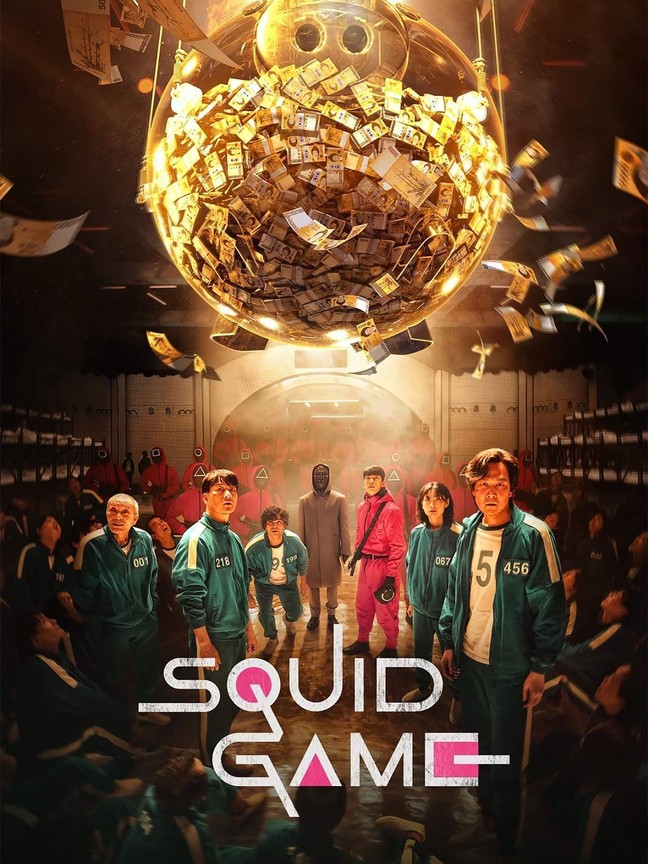
Squid Game
A couple of years ago, all that was known about the series “Squid Game” was that it would be an unusual drama coming from South Korea… and that Netflix had its fingers in it (the series, not Korea). Since Netflix in recent years has been sticking its fingers in everything alive and thus chasing a potential megahit, news about this series mostly passed under the radar.
And then on September 17th “Squid Game” appeared on Netflix… and in less than 10 days created chaos. It became one of Netflix’s most-watched series, number 1 in viewership in over 90 countries. What only lovers of Asian culture knew before was confirmed, which is that South Korea knows how to make good films and series. Money is dripping everywhere, South Korea is on the map no longer just because of the internet and “StarCraft” video game, and bigwigs from “Netflix” are opening 1,600-year-old whiskey to celebrate success, and to see if the next megahit could be found in Vietnam or Cambodia.
However, when the dust settles a bit, is “Squid Game” perhaps still just one excellent series, a short-lived wonder, and not some megahit for all time?
What, in fact, is “Squid Game”?
Seong Gi-hun (hereafter we’ll call him, and other heroes, by shortened names, e.g., Seong) is a divorced driver who’s in debt like any Balkan country (it’s not fair to just mention Greece, if you look at regional country debts). His (now) ex-wife has her life with another man. He’s supported by his (great-)grandmother who slips him hard-earned money. He’s the father of a likeable 10-year-old girl he doesn’t know how to parent because of his misery. All money he finds he spends on horse races, hoping to get some cash to pay back debts (because loan sharks keep their debtor books in order, as well as when to break whose legs if there’s no money).
In translation, Seong is on the edge of an abyss… and an ideal victim for exploitation, right?

Seong is contacted by a mysterious organization that offers him an opportunity to earn huge money… somewhere around 38 million dollars. And all he needs to do is participate in a series of children’s games and come out as winner.
And so Seong with 455 other contestants begins participation in a series of children’s games on one mysterious island.
This would definitely be a boring version of “Jeux Sans Frontières” with children’s games participated in by adults, right? And it’s not the fun “Ninja Warriors” either. What’s the catch in the “Squid Game” series?
Well, in this series of children’s games, if you drop out of the game, it’s not classic game over where you sit on the sidelines and sulk at yourself and patiently wait for a new match, or meanwhile go buy ice cream or run home to change your shirt.
Here, if you drop out of the game, a bullet follows.
In the head.
Literally.
From their arrival on this island, many things seemed strange to participants. For starters, organizers are all dressed in the same (pink) coveralls, and on their faces they have black masks that only differ in that a circle, triangle or square is drawn on them, and they don’t address participants but behave like mute moving dolls. Occasionally one of the supervisors addresses them when something needs to be clarified or the next game announced. And the leader of the whole organization is the mysterious “Front Man” who hides behind an unusual black mask, and often occasionally speaks in English with some people. For whom is he organizing all this, in fact?

Shock starts after the first game (“Red light, green light,” where players must run a certain distance; the catch is they can run while singing is heard, and as soon as it stops they must “freeze” in place, otherwise they’ve dropped out of the game, and so in a circle until time runs out). All who would make a mistake in this game would be riddled with bullets, to the shock of other participants.
Welcome to the deadly children’s playground. Where each game seems more innocent than the previous one, but rules are increasingly unpredictable, more shocking, participants fewer and fewer, and death more and more certain.
Are you ready to continue with these games?
That’s what this interesting series “Squid Game” wants to show us.
What set this series apart from others?
Well, for starters, it confirmed to the whole world that South Korea can make excellent films and series, and that Asia’s film world doesn’t consist only of Japan, China and India.
You’ll love some of the participants in these games, because you’ll discover both their external motives (obviously, it’s money to pay back their debts) for participating in these sick and deadly versions of children’s games, and their internal motives, as well as their true personalities. Seong is maybe a hopeless man and father who just wants to pay back debts to devote himself to his daughter, but he somehow deeply believes in the good in people despite the world’s evil. Cho Sang-woo is Seong’s childhood friend who was considered the wunderkind of their poor neighborhood and who managed to finish studies and become a successful investment team leader… but also stole people’s huge money and the police are chasing him (and on top of that he’s a psychopath). Kang Sae-byeok defected from North Korea and pickpockets people… but she wants money to finance an operation to transfer her family members from North Korea, as well as to get her little brother out of the local orphanage/shelter where she had to leave him. Oh Il-nam is an old man with a brain tumor, but who wants to participate in the challenge rather than wait outside for his death. Jang Deok-su is a gangster who wants to pay back gambling debts… and it won’t be hard for him to do anything underhanded to survive. Abdul Ali came from Pakistan to South Korea in search of a better life… but agreed to participate in these games because the corrupt construction site boss didn’t want to pay him for months, and he must support his family. And there’s Han Mi-nyeo who claims to be a single mother… but is actually a big manipulator and hides a lot of secrets.
Oh yes, and among the masked organizers hides one police detective, with his own motives…

Acting is also good, starting with main actor Lee Jung-jae (who’s quite popular in South Korea), who nicely conveyed emotions of on one hand a scared, and on the other hand a good man at heart, complete with facial expressions and facial tremors that reveal various emotions. But one should mention (probably unknown names to us) other actors like Park Hae-soo, Wi Ha-joon, Jung Ho-yeon (the girl is, by the way, a model, and very beautiful, but they made her unrecognizable for the series’ needs), Kim Joo-ryoung, Heo Sung-tae, O Yeong-su and many others who contributed to the overall (positive) impression of the series.
Visual and musical aspects are also nice and pleasant, standard for higher production of a series.
The plot itself didn’t leave some “wow” impression on me in terms of novelty, because I’m quite convinced the series’ creator was inspired by some old Japanese manga (comics) and cult film “Battle Royale,” which touched on topics like death games, manipulation of others and personality changes. But that doesn’t mean the plot is bad, maybe for me it just had that feeling of “already seen” in some form.
What I really didn’t like are the masked millionaire guests who speak in terribly bad and overly dramatized English, like you’d see in B or C category series/films. True, they have little screen time, but it stings both eyes and ears.
However, what is, at least for me, the champion of the “Squid Game” series?
The meaning of the series itself.

The plot, as a surface layer, isn’t anything special, but what’s hidden underneath, when we “scratch” a bit, is another story.
And that’s how far we’re willing to go for our goals, however good or bad. However much you like your series heroes, you won’t exactly be indifferent about what you feel toward them. For their goals like paying back debts and securing financial conditions for life (primary motive for 95% of participants), saving families, searching for excitement or something fourth, participants are ready to lie, manipulate, betray, negotiate, to (relatively) calmly watch the death of other participants, and even to kill. On one hand you’d want to understand them, everyone looks out for themselves and their nearest and dearest and there’s nothing they wouldn’t do for them (whether as child, spouse, parent or friend), but to go so far that others die because of you…
The most interesting detail is from the series’ beginning (small spoiler, but worth sharing), when after the first game more than half the participants die. One of the clauses for participating in the games says the only way to stop these death games is for more than half of (surviving) participants to vote to stop the game, and they did. However, when the organizer decided to restart the games only with remaining participants, almost all returned voluntarily! Because the possibility of earning 38 million dollars in a time of misery and despair makes you make your morals and ethical views of the world more “flexible” for your interests.
What will also be interesting is to see how, over time, people change under pressure and environmental influence, and begin to show their true faces. You’ll see a man who was timid his whole life, then slowly finds courage in himself, but manages to preserve faith in people. A person who seems rational and successful, but is actually an underhanded manipulator and psychopath. A weak and naive man who’s actually sharper than thought. A girl you’d say thinks of herself, but actually does everything only for others. A girl who seems uninterested in life, then discovers life’s meaning is having some goal. A man ready for all kinds of deals for additional information. A woman who presents herself as resourceful and cunning, but is actually a cunning and possessive manipulator. A man who presents himself as dangerous and everyone fears him, but is actually a weakling who can’t trust anyone.
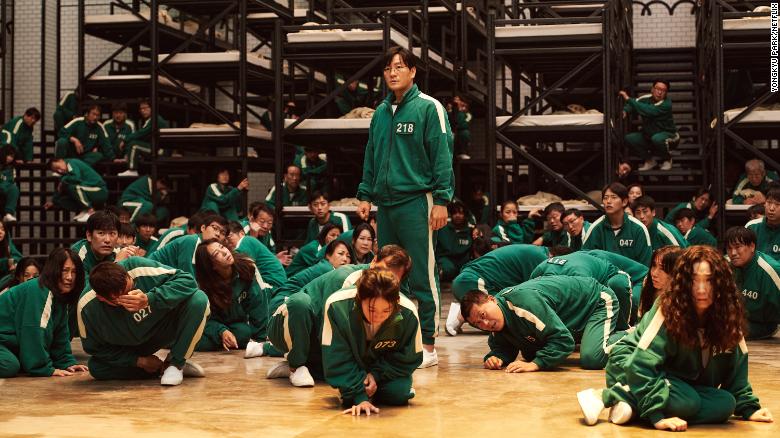
One of the “Squid Game” series’ questions is also how much a human life is worth (or better said, how worthless)… somewhere around 85,000 dollars. Namely, in the large hall where all participants sleep is one transparent glass chandelier in the shape of a pig’s head (symbolism related to slaughtering people like animals is more than obvious). Every time some participant dies (i.e., “drops out” of the game), about 85,000 dollars for each deceased participant is “poured” into the chandelier, and only increases the prize value, and thus the lust of remaining contestants… and thus strengthens their decision not to give up.
Here I thought a bit (both as “Kafa i Knjiga” and as BrankoS) about one question. The heroes of the “Squid Game” series decided, despite the risk of death (and so many souls they sent to death, either directly or indirectly), to continue “walking through Hell,” for their motives. Of course, morally and ethically, the reasons are wrong. If your moral compass is somewhat balanced, you know yourself that money isn’t worth others’ lives, although in life you primarily look out for your own interest. However, I couldn’t help but wonder if the series’ creator wanted to send some message.
Namely, you’ll occasionally hear comments from individual participants that they want to continue participating in these death games, because when they return “there” (meaning the real world and their lives), everything will be “same old.” The feeling of hopelessness, suffering, torment through life… I couldn’t shake the impression that “Squid Game” is nothing but a metaphor for “quick solutions” that are mostly destructive (whether physically, mentally or spiritually) and carry great risk for these people and people around them… such as criminal acts or drugs. Because participants in these games are also someone’s sons, spouses, parents… the desire to win for ensuring a better life is, on one hand, understandable, but on the other hand, the (potential) loss of your life is a loss for people close to you. If you’re ready to go so far for bad things (which ultimately still bring suffering to everyone), isn’t it better to direct that energy and ambition to fight for your life the right way, to persevere in the fight against life’s difficulties. People often say “there’s no way,” and life shows there is a way, we just don’t currently see it, in fact, it’s better to say, we don’t view the situation from other perspectives. These participants had a choice. They could have said “no” and found another way. Someone will say, “despair doesn’t choose,” but how many people used their despair as fuel to deal with challenges the right way? 🙂
I know, I strayed a bit from the series, but this is what, in my opinion, is the series’ pearl, those moral (and real) themes it deals with. 🙂

All in all “Squid Game” is an excellent series, I just wouldn’t call it a masterpiece or megahit and such. It left some open questions that could give space for a second season (if there is one, certainly not before 2023 or 2024), though even as one season it’s quite a rounded whole.
As far as I’m concerned, “Squid Game” is a very good series with good moral themes, but there are many, many better quality series. On the other hand, it has only nine episodes, so it’s definitely worth your time, just right to get a bit better acquainted with South Korean cinematography if you haven’t encountered it before. 🙂
And you, dear reader, do you know what game “squid game” actually is? 🙂
Trailer
IMDb | Rotten Tomatoes | Metacritic
Format: Series
Release date: 2021
Number of seasons: 1 (9 episodes)
Average episode duration: 45-60 minutes