







One Small Step Can Change Your Life: The Kaizen Way
Kaizen (noun): Japanese business philosophy of continuous improvement of work habits, personal efficiency etc. (definition from “Oxford Languages”)
Kaizen – literal translation from Japanese: improvement, perfection
Kaizen – something that sounds equally cool to say aloud as bankai, except the former is more realistic and applicable, although I’d give anything to possess bankai (my joking definition)
Kaizen – an approach that can truly improve every aspect of life, if you’re willing to have faith (in yourself) and patience. It really works (my serious definition)
I really love the kaizen concept (“You said ‘really’ three times in three consecutive sentences, change it up…” – note from subconscious). Not just because it originates from Japan (okay, that too :D), but also because it successfully proves it’s applicable to every aspect of life.
Though kaizen’s root came from the USA (“TWI program” that emerged after World War II and its implementation in Japan… there’s a lot about kaizen’s history on the internet, so I won’t bother with it here now), it became most recognizable thanks to “Toyota” which successfully applied the American method (which today we know as kaizen) and increased its productivity, efficiency and drastically reduced the percentage of damaged or defective goods during production.

You know how it is with the Japanese… you brought a proud (and extremely aggressive and militant, let’s not fool ourselves us Japanophiles) samurai nation to its knees with atomic bombs and left it in ruins. You sent them help in the form of knowledge on how to recover. The Japanese, proud yet humble and eager for change, accepted this method, then thought, “what would happen if we used this to truly improve our country and never stopped with this concept.” And so our Japanese got a bit carried away and forgot to brake… and now, some 70 years later… while you’re hesitating in the supermarket whether to afford yourself the luxury of two-ply toilet paper, in Japan you have a public toilet that’s cleaner than some (astrological) Virgo’s apartment with OCD and that plays the latest J-POP and offers seven options for how to wipe your buuu…um, you get the point yourself.
Anyway, today the kaizen concept is spread worldwide and long ago stopped relating only to production and logistics, but expanded to other branches and industries.
And over time came the realization that the kaizen principle could be applied on a private/personal level too, both to learn something new and to improve existing things. Some skill, health, relationship, love and what not.
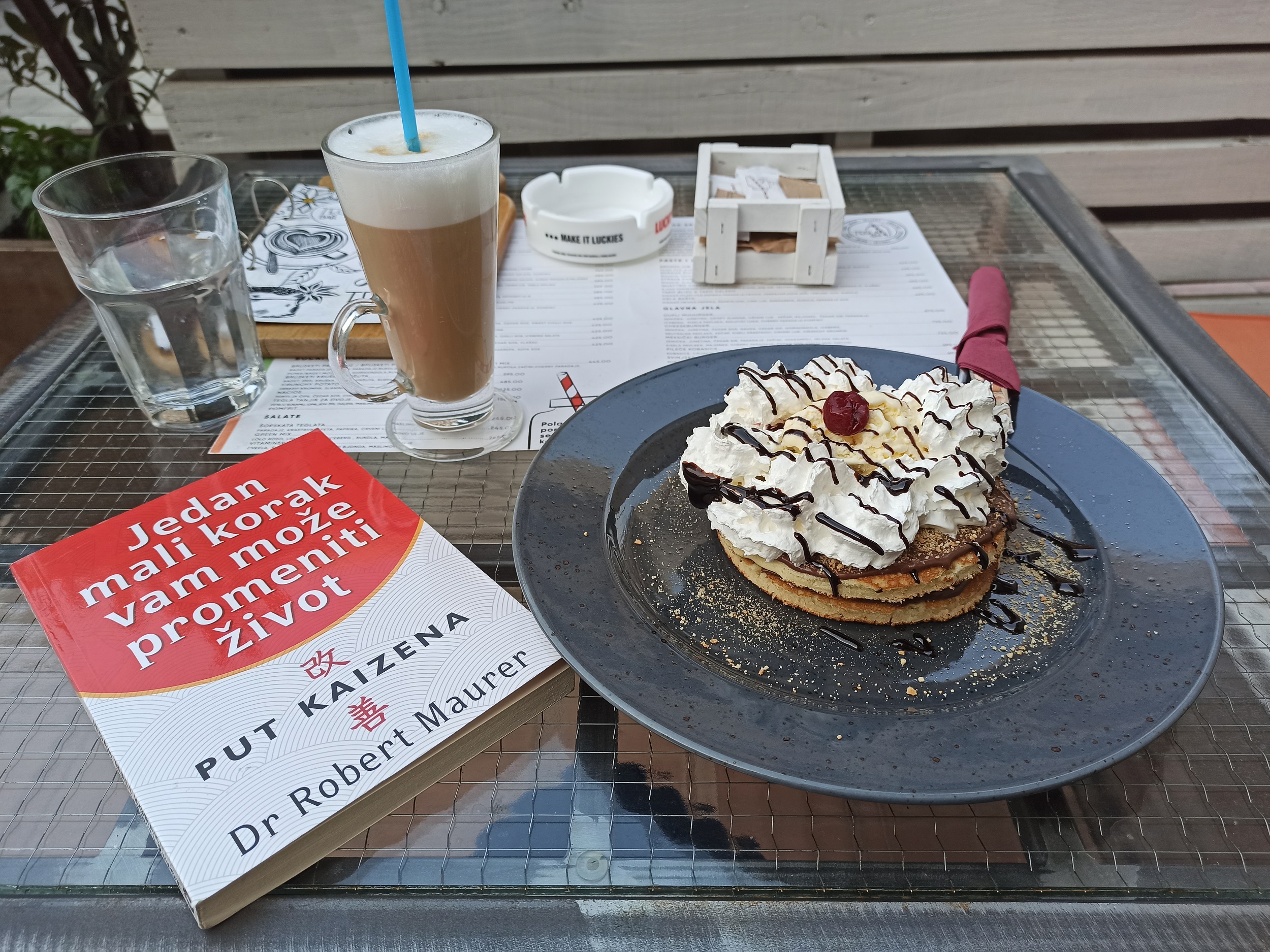
Here enters Dr. Robert Maurer. This clinical psychologist and kaizen expert (he’s worked with various corporations, organizations, hospitals, universities, and even the U.S. Navy) gave us the little book “One Small Step Can Change Your Life: The Kaizen Way,” with the intention of bringing us in a simple way the possibility of applying kaizen to our everyday life.

“A journey of a thousand miles begins with a single step” – Tao Te Ching
It’s interesting we could find kaizen’s root in wisdom that’s at least two thousand years old (like Tao Te Ching), yet in today’s modern, dynamic, fast (and instant) world, we somehow overlook it… or maybe rather ignore it?
“One Small Step Can Change Your Life” has seven key points/chapters (plus introductory part and conclusion):
- Why Kaizen Works
- Ask Small Questions
- Think Small Thoughts
- Take Small Actions
- Solve Small Problems
- Bestow Small Rewards
- Recognize Small Moments
Maybe you’ve (or maybe haven’t) noticed one key word in these chapters.
Small.
A word that in today’s times really means… well, small. 🙂 For “small” we have no patience, will or time. We want immediately big, grandiose, instant, powerful, to take big actions and reap big rewards, for something strong and innovative to happen.

Yet when such situations happen (or should happen)… sweaty palms, dry mouth, pounding heart, heavy legs, “block” in the brain… sound familiar? Fear has taken you under its wing! Do you know what’s actually happening to you at that moment? Besides cowardice, of course… 😀 A physiological change is happening in your brain (and body). If you’ve read even a bit about the brain, you know it consists of the reptilian brain, midbrain and cerebral cortex, and each is in charge of certain operations… and very often they function like a dysfunctional family in 20 square meters.
When we encounter a big challenge, the amygdala activates, with its famous “fight-or-flight”… though I’d rather say “fight or (mostly) freeze/paralyze or flee” response. This made sense in caveman times (so a tiger wouldn’t eat you), and makes sense today in many dangerous situations (if you’re an idiot and get in a situation where a tiger will eat you, avoiding a traffic accident, landslide etc…). However, human evolution has led to such sensitivity (or idleness) that the amygdala today “turns on” and creates panic for some situations it shouldn’t “turn on” for at all, even if they’re happening for the first time:
- you’re going to a job interview you desperately want (amygdala: DANGER! WE’LL DIE! RUN! PLAY DEAD! PLAY DUMB! IT’S DANGEROUS HERE!)
- you’re trying to approach a person of the opposite (or same, new times) sex (amygdala: DANGER! WE’LL DIE! RUN! PLAY DEAD! PLAY DUMB! SWEAT LIKE A PIG! STUTTER! SAY SOMETHING STUPID! IT’S DANGEROUS HERE!)
- you need to seriously exercise to lose weight (amygdala: DANGER! WE’LL DIE! RUN! PLAY DEAD! LET YOUR LEGS STIFFEN! WATCH TV! YOU’RE TIRED! EAT A COOKIE! IT’S DANGEROUS HERE!)
- you need to decide between pizza or pasta (amygdala: DANGER! WE’LL DIE! RUN! PLAY DEAD! EAT PIZZA! NO, EAT PASTA! YOU’LL CHOOSE WRONG! TAKE SOUP THOUGH YOU DON’T KNOW WHAT IT IS! START VOMITING! FAINT! IT’S DANGEROUS HERE!)
Maybe these examples seem funny to you, but ask yourself how many situations you’ve been in where you didn’t take action you wanted because fear paralyzed you, although you’re aware those weren’t really drastic situations that were literally “life or death”?
And now we return to this “small” that kaizen and “One Small Step Can Change Your Life” talks about.
Small, tiny, even trivial actions you’d do (and we’re talking about “small” in terms of quantity and effort) in most cases won’t activate the amygdala, because it won’t feel your comfort and safety are threatened. One cookie less, one cigarette less, one step more, one foreign word more, one page more read, one definition more learned, one sentence more written… the amygdala will let this slide. And if it lets this slide, then it won’t be scary at some point to start with two cookies less, two cigarettes less etc… simply, cumulative effect, compound interest (um, I mean figuratively from that period when interest on savings in banks made sense).
The author in each chapter simply addresses kaizen-related topics, examples from practice, practical application techniques (truly applicable), as well as useful advice, and the occasional (truly meaningful) quote.
The book really reads quickly, and not just because it’s only 150 pages, but also because it’s written in clear language and full of useful information. The recommendation is to have some marker or pencil next to you while reading this book.
“One Small Step Can Change Your Life” is a truly useful little book you’ll return to. For those who already know the kaizen principle it can give a mild expansion of knowledge in terms of application to the private aspect of life. And for those encountering this principle for the first time, it can be a nice and simple introduction to a quite powerful concept, which may interest them to research it a bit more on the business application front too.

Some people have a complaint how the book is too simplified and how it could be reduced to “small and safe steps to success because you have resistance to change.” Maybe they’re not wrong. However, I’m always interested whether these are positions of people who’ve truly managed to make big changes in their lives, or are simply “strong on paper.”
Such a book needed to be written. Sentence by sentence.
And it would eventually be published.
And let it be.
Because it wrote a big, yet small and simple truth.
And for someone it will therefore be useful. 🙂
And you, dear reader, do you also apply the kaizen principle in some aspect of your life? 🙂
Author’s website Dr. Robert Maurer “Science of excellence”
Book price: Harmonija Knjige | Vulkan | Dereta | Delfi
Ratings (and purchase) on foreign sites: Goodreads | Amazon | Bookdepository | Audible | Waterstones