






The Girl Who Leapt Through Time
For a large number of people, “The Girl Who Leapt Through Time” (jpn. “Toki o Kakeru Shōjo”) is probably associated with the animated film from 2006, which won audience sympathy. However, this title reaches far back into the past.
“The Girl Who Leapt Through Time” was originally published in a magazine for young people, in the period from 1965 to 1966, and appeared in novel form in 1967. Afterward came adaptations into several TV series, a live-action film, manga, an anime title and various audio dramas.
By the way, writer Yasutaka Tsutsui (the old man is still going strong at 88 years old) is also the writer of the novella “Paprika,” which also received a (very popular and successful) anime adaptation.
But, let’s return to the novel…

Meet 15-year-old Kazuko Yoshiyama, a student in her final year of junior high school. With her two school friends (short and impulsive Gorō and tall dreamer Kazuo) she was one day cleaning the rooms of the school’s science laboratory. At one moment she was left alone and then heard a noise from one of the science laboratory rooms, and when she went to see what was happening, she saw a broken test tube and thought she saw a “shadow” there too. However, due to the intoxicating scent from the test tube (which resembles lavender), Kazuko fainted. Fortunately, Gorō and Kazuo soon found her. When she recovered, they all attributed it to fatigue and Kazuko returned home.
Soon after, Kazuko begins having nightmares that disturb her (like her friend’s house being in flames).
The next morning, Kazuko experienced a traffic accident and perished…
…and that would be the end of the novel, if Kazuko, for some reason, hadn’t woken up in her bed, and realized the day had gone “back.”
Scared and confused, Kazuko shared this experience with her friends Gorō and Kazuo. Although skeptical about what she told them, aware that their friend was upset, and taking into account the mysterious “accident” in the science laboratory a few days earlier, they assessed it would be best for all three to go to Professor Fukushima, their science teacher, to ask for his opinion. Fukushima, like any scientist, didn’t immediately think his three students had gone crazy, but took as a premise that perhaps Kazuko has the ability of teleportation, as well as “leaping into the past or future” (time-leap).

Kazuko is not at all thrilled with the idea that she alone possesses this “gift” and is the only one aware of the consequences of moving through time, and because of that decides to start searching for the mysterious shadow she saw in the laboratory, hoping to uncover the identity of the person who made, and then broke, the test tube with the strange liquid (because of which she fainted, and apparently also received powers). And how she’ll react to discovering that person, I’ll leave for you to find out.
“The Girl Who Leapt Through Time” is a short novel, written in very simple language, without excessive “description.” Although it fits into barely 90 pages, for a work written in the mid-60s, it touched on some very serious, but also interesting themes. For starters, the works of Yasutaka Tsutsui (including this novel) are characterized as the foundation for Japanese postmodern science fiction. “The Girl Who Leapt Through Time” can easily be placed in the science fiction novel category, because it touches on the concept of teleportation, as well as time leaping. And there’s also the time-loop element (i.e., the situation where a person relives the same scenario again), which Hollywood later popularized with the cult film “Groundhog Day.”
Although it’s a short novel, it touched a bit on adolescence as well, as well as moments when a person starts to question themselves and their actions.

All in all, this is a solid novel, about which there’s no doubt that the concept behind it was developed through other media (as “Blade Runner” did with the book “Do Androids Dream of Electric Sheep”), and for lovers of Japanese literature and sci-fi elements, this is solid reading material.
The “Tanesi” edition includes one more Tsutsui novella, which is “The Stuff That Nightmares Are Made Of,” which is more of a psychological mystery with horror elements, and follows high schooler Masako who tries to find out why her little brother is afraid to go to the bathroom alone at night and would rather wet the bed (and be the subject of friends’ mockery) than meet in the dark the “scary woman with scissors.”

Although Masako is convinced her little brother is just imagining things, his serious (not to say primal) fear also slightly affects her, because now she too starts questioning her fears, like why she’s afraid of “dusty masks” or bridges. Is it just irrational fear, or is the reason buried somewhere deep in her subconscious… or past?
“The Stuff That Nightmares Are Made Of” is a novella of barely 50 pages and is likewise simple in plot and form, but interestingly touched on themes like traumas and confronting fears. Likewise, it very nicely showed how the ways people close to us (like parents) behave toward us can shape our behavior, including fears, especially when we’re small (both in size and in years). At that age, it’s not all just in the tone and manner of treatment, something is (literally) also in the words we speak.
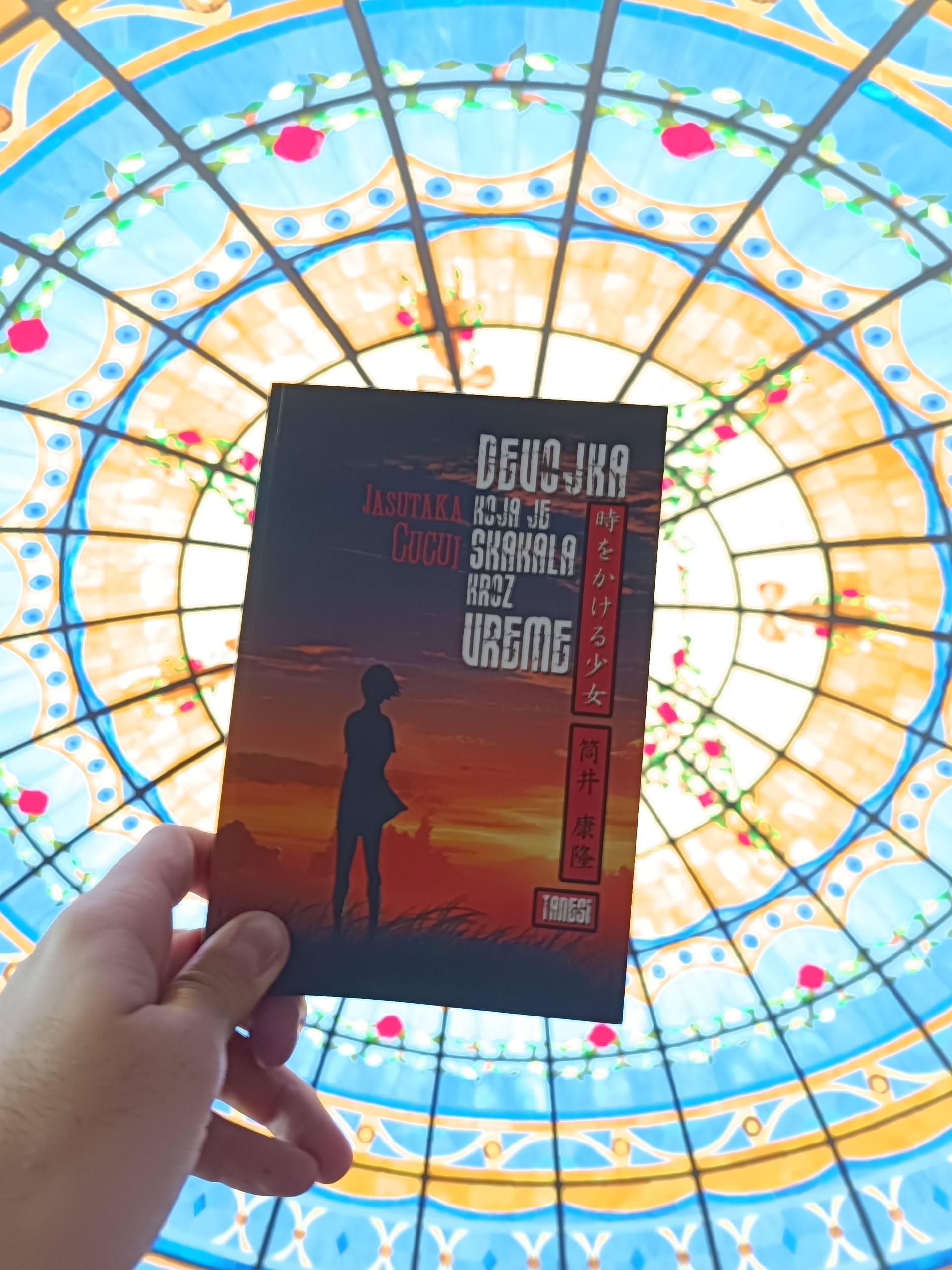
Therefore, in this edition you have two quite solid novellas. 🙂
And you, dear reader, are you familiar with “The Girl Who Leapt Through Time”? 🙂
Book price: Tanesi | Vulkan | Delfi | Makart
Ratings (and purchase) on foreign sites: Goodreads | Amazon | Bookdepository | Waterstones