





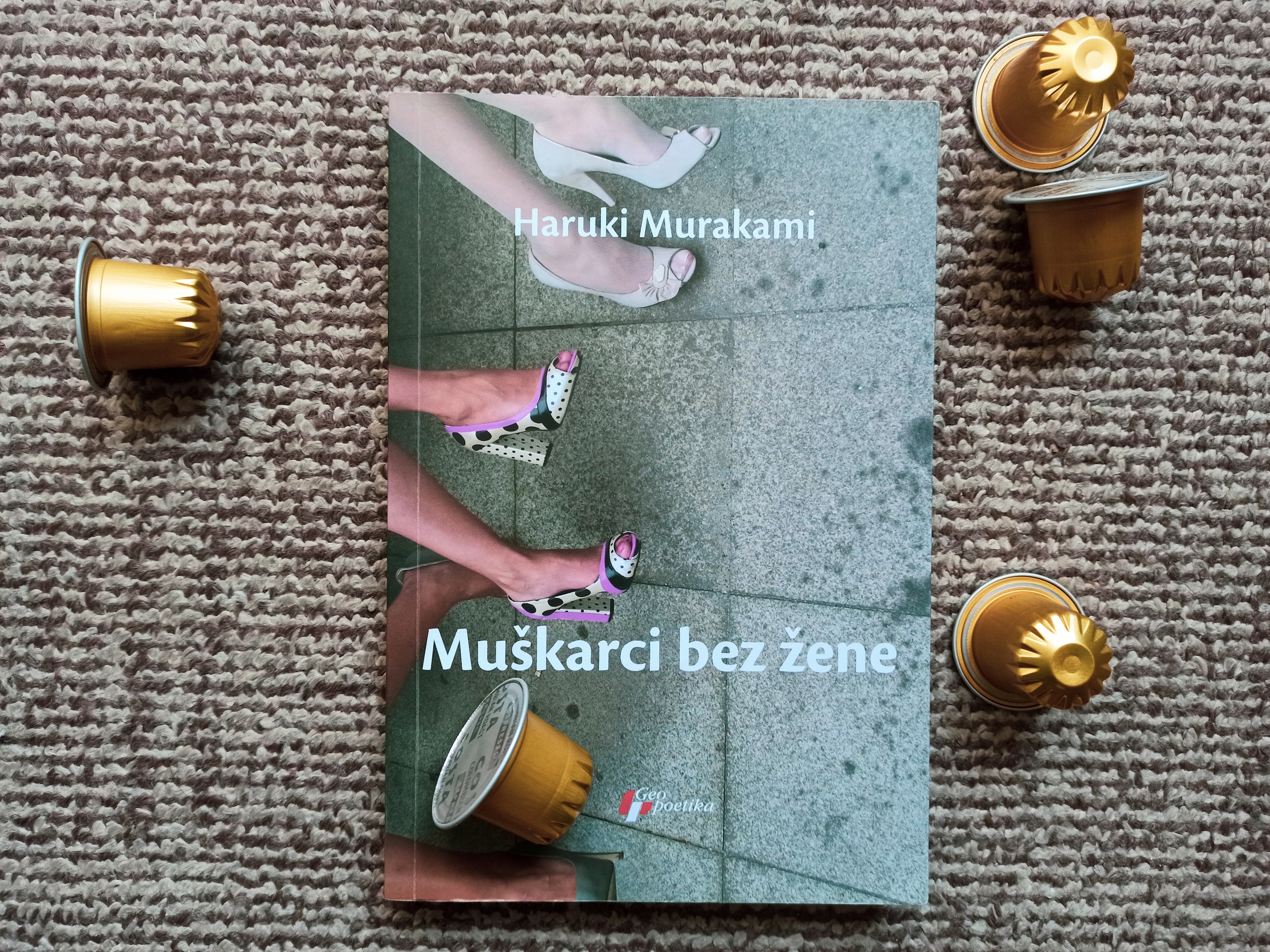
Men Without Women
[Text started somewhere in spring 2017, preserved in original, without any changes]
Haruki Murakami is a specific beast in the world of prose. People experience him either as a genius or as literature’s oddball. But the fact is his works leave no one indifferent.
I consider myself his admirer. For me his approach to writing has always had something that deviates from standard (even for Japanese) writers. Regardless of whether we’re talking about real life stories or fantasy, that avalanche of irrationality that bursts from his books often makes you ponder what you’ve just read.
I was mildly surprised learning his newest (published here) work is a story collection. Murakami’s novels are generally extensive, and he always slowly weaves his threads around the reader, while gradually drawing them into his rational-irrational world. And the theme of these stories… men abandoned by their wives and their coping with the voids they left and their lives after abandonment. God, surely we won’t see some pathetic and miserable Murakami here? True, he touched on themes of love and defeat before, but… seven sad and depressive stories?
It turned out there was no reason for concern. Before us is good old Murakami. Maybe a tad different because of text form and themes he touched on, but it’s still the Murakami we know. Stories are truly told to resemble mini-novels. The unavoidable jazz music is still there, deep and specific thoughts of main heroes, noir atmosphere… and of course cats. As the author himself would say: “This collection is what in music would be called a concept album.”
Well, let’s see what “tracks” were served this time?
Drive My Car – Middle-aged actor Kafuku, by circumstance, must hire a driver. And for driver he gets none other than a girl, which doesn’t thrill him at first ball. However, over time he realizes Misaki’s presence as driver doesn’t bother him at all. Moreover, during driving he spontaneously opens up to this girl, and from his confessions we learn about his late wife, their love, her affairs (which Kafuku knew about), as well as friendship with one of her lovers. Aha, very interesting events in the life of one now middle-aged actor.
Yesterday – The main hero tells us about his friendship with unusual guy Kitaru who, for some reason known to him, intentionally speaks with an atypical accent, is completely uninterested in further schooling, loves to philosophize a lot (better said, to babble) and has a quite undefined relationship with his girlfriend Erika. Moreover, when introducing our main hero to Erika, Kitaru had the “brilliant” idea that the main hero could see Erika instead of him. And she agrees! What do you think, in what direction did their date go and what realizations did this story’s heroes gain? And what happened 16 years later?
Independent Organ – Told from the narrator’s perspective, this is a story about aesthetic surgeon Tokai, who has everything a man could wish for. His own private business, lots of money, women (he is an aesthetic surgeon after all)… and no intention to marry. A man who enjoys casual relationships and even more casual sex with married women while in several parallel relationships (one greedy scoundrel, it’s not easy for him :D). But what happens when the scoundrel (“Don’t worry readers, pure author’s jealousy” – note from subconscious) Tokai falls in love with a married woman? What goes through his head then and what happens to him?
Scheherazade – in Japanese version. Except here Scheherazade is a 35-year-old housewife (married, has two children), who has absolutely no similarities with legendary Scheherazade. She visited Habara twice a week and brought him groceries, but also used her visits for sex sessions. But here the accent isn’t on sex (I can’t believe I wrote this…), but on what’s after sex (and no, I don’t mean cuddling). And those are twisted stories Scheherazade would tell Habara. But special accent is on her story when she first seriously fell in love in high school and broke into her crush’s apartment (hm… maybe I should check the lock on my door).
Kino – not cinema, the man is really called that. A person who got sick of working in a company dealing with handmade sneakers for top athletes, so he quit… actually, more likely because he found his wife in their apartment with his colleague while they were, uh, “closing the deal.” And Kino was quite done with everything then (and who wouldn’t be?). He quit, divorced and opened a bar for his soul. Anyway, what makes this story stand out from others is what Murakami is otherwise recognizable for. A cat’s appearance, as well as a dose of mysticism, embodied in one of the bar’s regular visitors, unusual Mr. Kamita. Namely, a week after he slept with one of his female guests (who had cigarette burns on her… really, people and their fetishes), the cat disappeared, and snakes slowly began gathering around the bar. Mysterious Kamita then advises Kino to close his establishment for a while, because the place became “tainted” and to travel around Japan a bit.
Samsa in Love – Uh, this is convincingly the most twisted story. How to summarize… Gregor Samsa wakes up in an old house, unsure what’s happening outside and why he’s alone in the house. Soon he’s visited by one unsympathetic hunchbacked girl, with the intention to fix the door lock. And while she’s twisting around the lock (partly due to hunchback, partly due to drill problems), Gregor slowly, um, raises the flag. Come on, don’t look strangely at this text, this is still Murakami…
Men Without Women – The narrator is called at one in the morning by an unknown man who tells him his wife (i.e., unknown man’s) committed suicide, then hangs up. Is it any small thing to say the narrator was in a relationship with that woman when they were 14 years old? To be honest, I wouldn’t reveal much about the narrator’s thoughts, I really think you should read it, because it didn’t deserve to be on this collection’s cover page for no reason.

[Text continued and finished in winter, early December 2021. Midnight has passed, and in the silence and sleepiness of night at the moment of writing, unexpectedly in the background the song “Vai” by music duo “Calema” is heard… and vai in Portuguese means “go”… as if the musical spirit of random music sensed what topic I’ll write about]
A day or two ago I read news that the film “Drive My Car” appeared, based on Murakami’s story of the same name “Drive My Car” from his collection “Men Without Women.” I made a mental note to watch the film in the near future, because the film’s title “clicked” for me and, though the plot was hazy, I remember the complete story collection left quite a (positive) impression on me, mixed with pensiveness, confusion, nostalgia and melancholy (which are, you’ll agree, emotions that almost always accompany the reader when hanging out with Murakami).
The same day, some hour or two later, while searching through my (overcrowded) computer, I found some prehistoric folder (creatively named New Folder) and for form’s sake clicked on it before deleting. There stood only one word document – mbz.doc.
At that moment it hit me. Impossible! What crazy coincidence would that be!?
It was my started review of the collection “Men Without Women” from 2017… no wonder I was always bothered that one of my favorites “What I Talk About When I Talk About Running” wasn’t the first Murakami review I wrote (though it’s the first published here), and I didn’t know why…
I quickly read the review and, like in movies, flashbacks started. Not only did general memory of story plots return, but from some old memory archive like butterflies flew out emotions that accompanied their reading (“I’m quite sure dusty moths fly out from old archives… but since this is a nostalgic moment for me too, today you’ll be spared mocking from my side… write this day in the calendar…” – note from subconscious)
Yes, this is one form of classic Murakami. The one dealing with encounters of unusual (not to say strange) people and “gray” emotions accompanied by irrationality, loneliness, unrequited love, ambivalence, double identities, unpredictability…
However, unlike the (most) recent collection “First Person Singular,” “Men Without Women” is (to my memory) obviously at least two levels above his newer collection. I already mentioned “First Person Singular” is perhaps his weakest novel for me so far – I simply placed it in the “okay” category. I know it awakened anxiety and reading effort in me at moments. It even mostly evaporated from memory, although I read it recently… maybe because cats weren’t mentioned anywhere? That’s how big a magical influence those unpredictable four-legged meowers can have… And here, “Men Without Women” returned to my memory after so many years, with positive impressions, even if you take into account the quite “gray” theme (especially for us men).

And what does publisher “Geopoetika” say?
“Ernest Hemingway’s story collection ‘Men Without Women’ was certainly an inspiration for Murakami to process in a completely personal way characters and feelings of men from whom women left under different circumstances. Heroes of his stories become best friends with lovers of their ex-wives, give their teenage love to best friend, travel lonely because their wife left them, while on that journey, as in ancient myths, snakes guide them, they die from unrequited love. Familiar motifs, but in original, Murakami packaging, make a work full of hidden passion. These are also stories about ambivalence, about double identities, about how we don’t see ourselves, how sometimes we least know those we live with.“
Obviously we agree. There’s quite a dose of mysticism in this Murakami collection from 2013, which is one of his trademarks.
All in all, “Men Without Women” is a good story collection. An interesting fact is he’s published five so far, and this is his fourth in order, so it would be interesting to see how he wrote stories even earlier.
For novels we’ve, in principle, convinced ourselves so far he knows what he’s doing, right? 🙂
And read this collection… and then take a look at the film.
I know I will…
And you, dear reader, which story from this collection caught your attention? 🙂
Author’s website
Book price: Geopoetika | Delfi | Vulkan | Makart
Ratings (and purchase) on foreign sites: Goodreads | Amazon | Bookdepository | Waterstones | Audible