






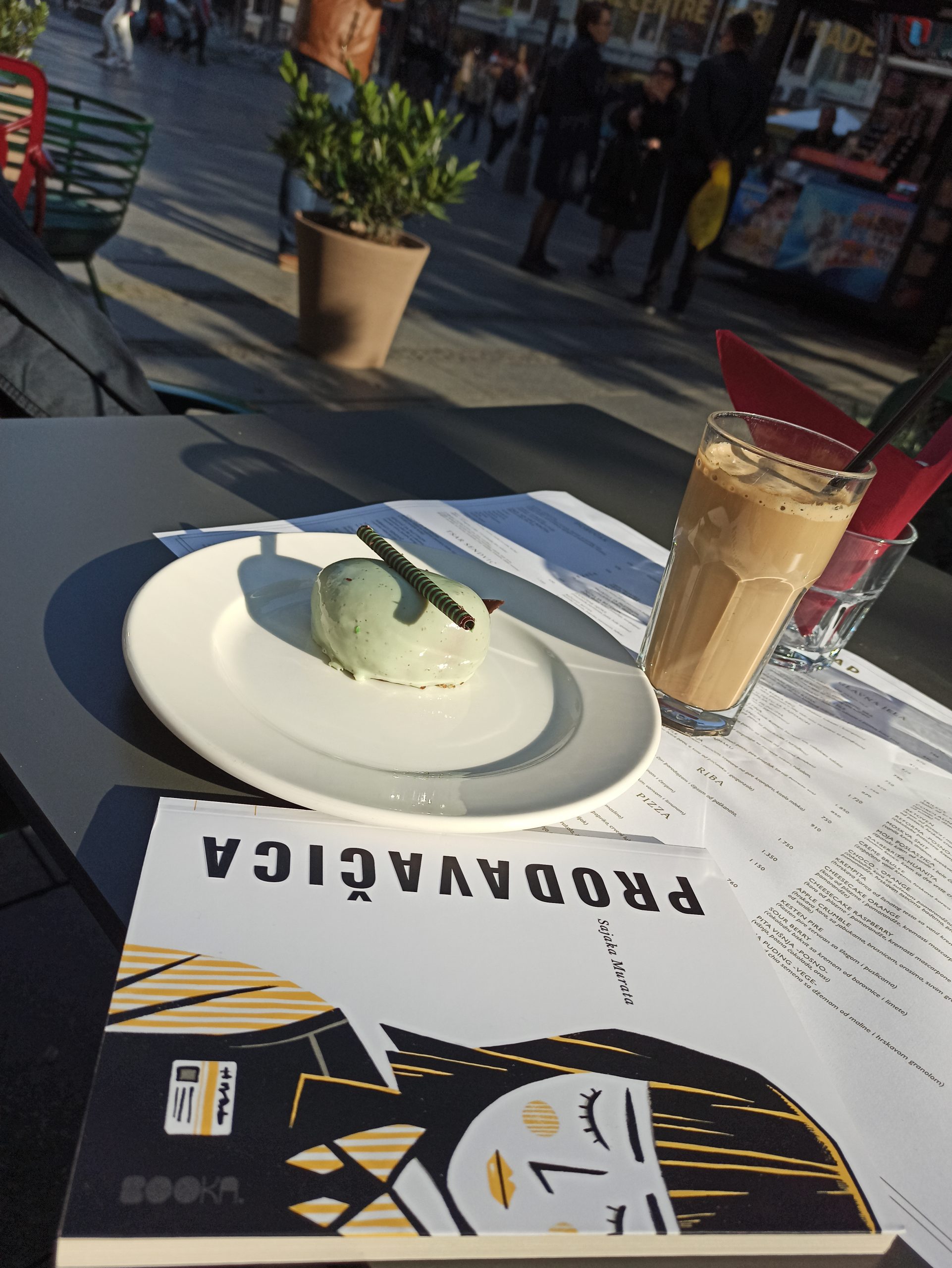
Convenience Store Woman
Uh, you don’t exactly feel indifferent when you finish the novella Convenience Store Woman… you’re not even sure how to position yourself toward the main character. Do you like her, is she endearing, problematic, do you pity her or try to understand her… but that’s precisely the point of this book, and that’s where Sayaka Murata hits the mark perfectly.
The heroine of Convenience Store Woman is Keiko Furukura. She is 36, and has been working as a part-time clerk in the same convenience store for over 18 years. From the outside (and from the perspective of Balkan standards and economy), this would probably make you shrug. And that would be a very understandable reaction. What we don’t know about people and the jobs they do are the reasons and circumstances why they’re where they are, right?
But what if I told you the story takes place in Japan (“Yeah, sure, never would’ve guessed, domo arigato… baka…” — says the subconscious), that Keiko works part-time in a convenience store, that she has never had sex or a romantic relationship, that she is socially maladjusted (though she does have a few friends/acquaintances) and that the convenience store is the only place in the world where she can, at first glance, appear as if she fits in somewhere?
I’m guessing that raised an eyebrow—or both?
From childhood, Keiko Furukura was… let’s say unusual in her reasoning. As a child, dead birds did not evoke sadness in her (and she couldn’t understand why people would feel sad about them), but rather the thought that they could be used as food. At school, when two classmates were fighting and someone screamed “stop them right now,” she interpreted that as a call to prevent the conflict at any cost—so she grabbed a shovel and smacked one of them over the head (and not in a comedic way). Her parents were uncomfortable, the teachers were uncomfortable, the school psychologist was uncomfortable, the janitor was uncomfortable. It was obvious that little Keiko didn’t really “get” how some things work, which resulted in her withdrawing into herself and becoming quiet and passive (so she wouldn’t say or do something that seemed logical to her but was seen as “problematic” by everyone else).
She found salvation when she was 18 and started working at a newly opened convenience store. Her parents were relieved, thinking she would gradually adapt to modern society and become “normal.” However, Keiko kept working at the same store for the next 18 years, still part-time, showing no real enthusiasm for changing jobs. On top of that, she struggles to explain (i.e., invent) reasons to the few friends/acquaintances she has as to why she is still single and why she’s been doing the same job for 18 years. Her parents have resigned themselves to her fate, and even her younger sister, who adored her as a child, tries to understand Keiko as best she can.

In the meantime, Keiko meets Shiraha, who managed to last exactly one day working at the store before being fired. Shiraha is completely unkempt, messy, smelly, constantly criticizing “society” and everything “normal,” and blaming the world for the fact he can’t hold a job, that women don’t like him, and that he hasn’t found a woman with money to finance his business (whatever that might be). He has problems with his brother and sister-in-law, from whom he constantly borrows money without ever paying it back. He still views the world through the lens of a tribal community where alpha males (in terms of strength and money) get the best women and everyone else gets “leftovers” or is doomed to “extinction.” Someone might call Shiraha a critic of modern society (“But we all know he’s just a lazy, rude, spoiled and sexually frustrated a** of a man and a world-class jerk” — adds the subconscious).
And God only knows how, but they somehow come up with the idea that Shiraha should move in with Keiko (in reality, it’s entirely his idea). Shiraha still won’t work, he’ll just demand that food is brought to him (meaning Keiko will bring it) into the bathroom, he won’t show any emotion toward Keiko (because he doesn’t like her at all) and there will be no sex (as he will repeat several times, because she is, in his opinion, too ugly for his standards and her train “has long since left the station”). But by freeloading at her place, Shiraha will be “doing her a favor,” because she will finally be able to tell her parents and friends that she lives with someone—and they will leave her alone.
From Keiko’s perspective, she gets the impression that Shiraha will live in her apartment like some sort of pet, but she accepts his proposal in the hope that she will now appear more “normal” to others.
Will love eventually blossom between Keiko and Shiraha? Will the people around them finally accept Keiko as a “normal” member of society? Will Keiko move from the role of clerk to manager (or quit completely)? You’ll find the answers to these and many other questions if you read Convenience Store Woman. 😀
Though I can tell you right away—and I think you’ll agree this isn’t really a spoiler based on what you’ve read so far—don’t expect the expected expectedly expected answers… ^^
The central figure of the novella is, of course, Keiko. It quickly becomes clear that she is indeed “missing” something (“Hehehe, I know exactly what she’s missing…” — subconscious takes off into the sky, immediately nuked by a feminist Kamehameha wave from social media). It’s hard to define what that “something” is. Is it a classic psychological disorder? Probably. But it’s fused with something else. Is it the absence of empathy for herself and the world? Some might even call it an absence of a soul. Because the more you get to know Keiko, the more her behavior and reasoning starts to resemble that of a robot.
This is most evident at the convenience store, where she appears “normal” as a clerk. Convenience stores (especially in Japan) operate (or at least strive to, if this novel is to be believed) according to precise rules. You rehearse “good afternoon,” “thank you,” “please,” “sorry,” “right away,” “on sale today,” you learn exactly where to place which product on the shelf, and you follow a set choreography of body language, tone of voice, and overall demeanor. Keiko mastered all of this quickly, but she also realized that, over the years, she’s started to recognize different customer types, their behavior, and what they buy… to the point where, over time, she can almost predict what a customer will buy or how they will act. Someone might say there’s no special talent in that—that in a fairly monotonous job, routine allows us to develop “skills” that might look a bit uncanny from the outside. But in Keiko’s case, you still can’t be sure whether it’s talent, a sense of “flow” while working, or simply an absence of emotion—like a robot (though she claims she “hears the store’s voice”).
Her connection to the store goes so far that she absorbs the behaviors of her colleagues (their body language, way of speaking, tone, even clothing style) and creates her own mix. With a “normal” person, this would actually be impressive (we’d say the person is a natural at adaptability, rapport, NLP and all the other cool technical terms for skills that help you “connect” more easily and be more likable to others). But if we look at it from the perspective of someone not quite “normal” (like Keiko), this starts to make us uneasy, and you often get the feeling the novel is sliding into psychological horror—which is a very interesting shift, because you’d expect a story with such a “robotic” protagonist to be far more monotonous.

On the back cover, the blurb says: “A brilliant novel about misfitting and misunderstanding, portrayed through the psyche of an unforgettable heroine, became a major hit…” and so on… and that’s not far from the truth. The novella definitely doesn’t leave anyone indifferent—neither with its characters nor with its (very serious) subject matter. It opens up a whole range of questions about people who struggle to fit into today’s society and its norms, and who receive little to no understanding from their surroundings. Especially when it comes to people who are “in the middle” psychologically. The situation is clear when someone is simply very introverted, shy, or dislikes having a large circle of friends but is still reasonably functional as a member of society (where the issue is mainly mental/psychological/motivational), or when it is obvious someone has severe issues and poses a danger both to themselves and others (where we’re talking about mental illness). But what do we do with people like Keiko, who are somewhere in between—or who lean more toward the second group?
Is the solution for society to intervene and try to help, or to remain neutral and let them live their lives as they see fit, as long as they (supposedly) don’t endanger themselves or others? Honestly, I’m not sure whether we should slap a “crazy” label on Keiko and send her for observation, or simply see her as someone who never emotionally matured, because no one worked with her in a way that would help her recognize certain things. It’s a very serious, intriguing, and heavy topic.
Another question that comes up (and ties into the previous one) is whether modern society is even aware of how much pressure it exerts on people—so much so that we begin labeling certain lifestyles as “abnormal” when they might simply be harmless choices that don’t hurt anyone. Just as adult Keiko might be seen as a strange person (maybe even “abnormal”), someone else might see her simply as emotionally cold, not particularly interested in the world, love, or sex, who finds contentment in leading a simple (and somewhat neglected) life and working in a convenience store. There is pressure on people who live alone, who don’t want children, who want a family later, whose career is their top priority, people with different sexual orientations, the middle class struggling (or unable) to pay their bills on time, and so on. So who is actually causing the problem? These groups—or society (and its expectations)? Or is it both?
Despite the unusual nature of the protagonist and the heavy themes, the novel (told in first person) is surprisingly easy to read. On the contrary, it’s quite fast and engaging—you keep turning the pages, wondering if (and what kind of) change will happen to Keiko. In fact, only after you finish the novel and a few days pass (as happened to me), do you suddenly realize how many questions begin to surface and how many complex themes are hidden in under 120 pages of Convenience Store Woman.
Convenience Store Woman won the prestigious Akutagawa Prize in 2016. Entirely deserved.
All in all, a very interesting—actually, an excellent—novel that would be a real shame to skip. 🙂
And you, dear reader, how did you perceive the main character, Keiko? And are you now watching the staff in your supermarket a bit more closely? 🙂
Book price: Booka | Delfi | Vulkan | Makart
Ratings (and purchase) on international sites: Goodreads | Amazon | Bookdepository | Audible | Waterstones