







The Hard Thing About Hard Things
“I ask my children: what is the difference between a hero and a coward? There is no difference. It’s only what they do that differs. They both feel the same. They’re both scared of losing their lives or getting seriously injured. The coward refuses to face the inevitable. The hero is more disciplined and manages to overcome his feelings and does what must be done. But they both feel the same. People who watch you judge you based on what you do, not what you feel.” – Cus D’Amato (legendary boxing trainer)
When it comes to books combining autobiography/memoirs/business stories, you’ll not infrequently come across stories by authors who mostly glorify their successes and how they achieved miracles, created millions/billions, etc… and obligatorily, they love to act wise as if they drank all the wisdom of this world.
Some businessmen are an exception, and like to share stories from the more emotional side. Others like to share about the importance of (inter)human relations and a kind of case-study of their company. And some like to combine all of the above in the form of a dynamic story from zero to leading a company worth billions and billions.
And then there’s Ben Horowitz and his book “The Hard Thing About Hard Things: Building a Business When There Are No Easy Answers.” Simply, the book title perfectly describes what this is about, and that’s why this book is excellent.

If you’re interested in how truly great a challenge it is to be a CEO and what difficult decisions you must face as one, this is the book for you. And even if you have no desire or ambition to be one, this is still a book about leadership.
“The Hard Thing About Hard Things” is divided into the following chapters:
- From Communist to Venture Capitalist
- I Will Survive
- This Time With Feeling
- When Things Fall Apart
- Take Care of the People, the Products, and the Profits—In That Order
- On People and Culture
- How to Lead Even When You Don’t Know Where You’re Going
- First Rule of Entrepreneurship: There Are No Rules
- The End of the Beginning

The first three chapters talk about Ben Horowitz’s path from programmer at “Silicon Graphics” to one of the vice presidents of “Netscape,” and later “AOL.” After that, Ben decided on an entrepreneurial path and became one of the founders of the company “Loudcloud,” and then the (painful and exhausting) transition of that company into newly formed “Opsware” as its president and CEO. The company struggled with major challenges and (drastic) oscillations, but in the end Ben sold the company in 2007 to “HP” (Hewlett-Packard) for an excellent 1.6 billion dollars.
This introductory part is told very dynamically and tensely, which is very unexpected for a business book. One of the main reasons is also that the story isn’t about how everything is milk and honey and how you just need to believe in yourself and billions come by themselves, blah blah… but rather how you need to be ready to make difficult decisions… in fact, you’re never ready, you just have to make difficult decisions anyway.
However, “The Hard Thing About Hard Things” only truly becomes interesting from the fourth chapter. Ben Horowitz begins to analyze scenarios faced by companies and CEOs, drawing parallels with what was happening in his companies, as well as how to approach solving some problems.

Why does the book justify its title? Well, just look at some of the uncomfortable topics the book addresses:
- Why should a CEO always be honest?
- What is the correct way to lay off people? And how to lay off executives?
- How do you demote a friend?
- What are “lead bullets”?
- Why should startup companies train their people? (though I personally would replace “should” with “must”)
- Is it okay to hire people from a friend’s company?
- How to hire an executive? And how to bring in an executive from a big company?
- How to ensure management quality?
- How to minimize political games in your company?
- What kind of ambition is correct?
- How to approach titles and promotions?
- What to do with smart people who can turn out to be bad employees?
- How do you program culture?

What do you think, do the questions seem serious, ticklish and uncomfortable?
Ben Horowitz will also try to demystify the process of scaling a company, what are the hardest CEO skills to master, when to be a wartime and when a peacetime CEO, how to become an excellent CEO, how to deal with the paradox of “accountability VS creativity,” how to stay at the top level… and one of perhaps the hardest questions: “When to make the decision to sell the company.”
All these chapters are written quite seriously and directly, yet simple to read. What’s particularly interesting is that the author doesn’t take the position of being the smartest or that his views are (always) correct. On the other hand, he doesn’t take the classic diplomatic approach either, in the sense of “these are all potential solutions, so choose the ones you like best,” but tries to make it clear to us that being a leader means very often choosing between two (or more) evils, and trying to assess which will be the least.

As I commented in the book “Drive” by Daniel Pink… looking at the trend happening in the IT industry (with which this book is also connected), with all the layoffs of large numbers of employees (which are often initiated and simultaneously concluded by email), I can’t help but wonder whether people in leadership positions (and that especially includes CEOs) read at all? Everyone loves to quote something from some books, and I wonder if they even understand the meaning of what’s written in the book? Of course, many will say “theory is one thing, what’s written is all nice, but practice is another,” however, do people ever set aside time to try to improve their practice with the experiences of others? And do they ever question the correctness of their practice?
Simply, if a company has problems, it should start with the saying that “a fish rots from the head.” Responsibility always starts with people at the top. The fact is they can’t supervise every employee (and they shouldn’t, micromanagement of employees isn’t a solution), but they should pay attention to the people they place in positions of great responsibility. Because if you don’t choose a quality person with integrity… well, I’ll just say that various managers (sales, HR or something else) will always look for the culprit in those below them, because they’ll want to protect themselves… because it’s always “less painful” to replace a soldier than a general. The problem arises when the CEO isn’t aware of having a bad general, who will have no problem replacing good soldiers… I’m just saying, if turnover is high (i.e., retention is low), then the CEO should start thinking a bit differently about where the problem lies. But don’t pay attention to my comment, that’s a topic for another time… and another blog. 😉
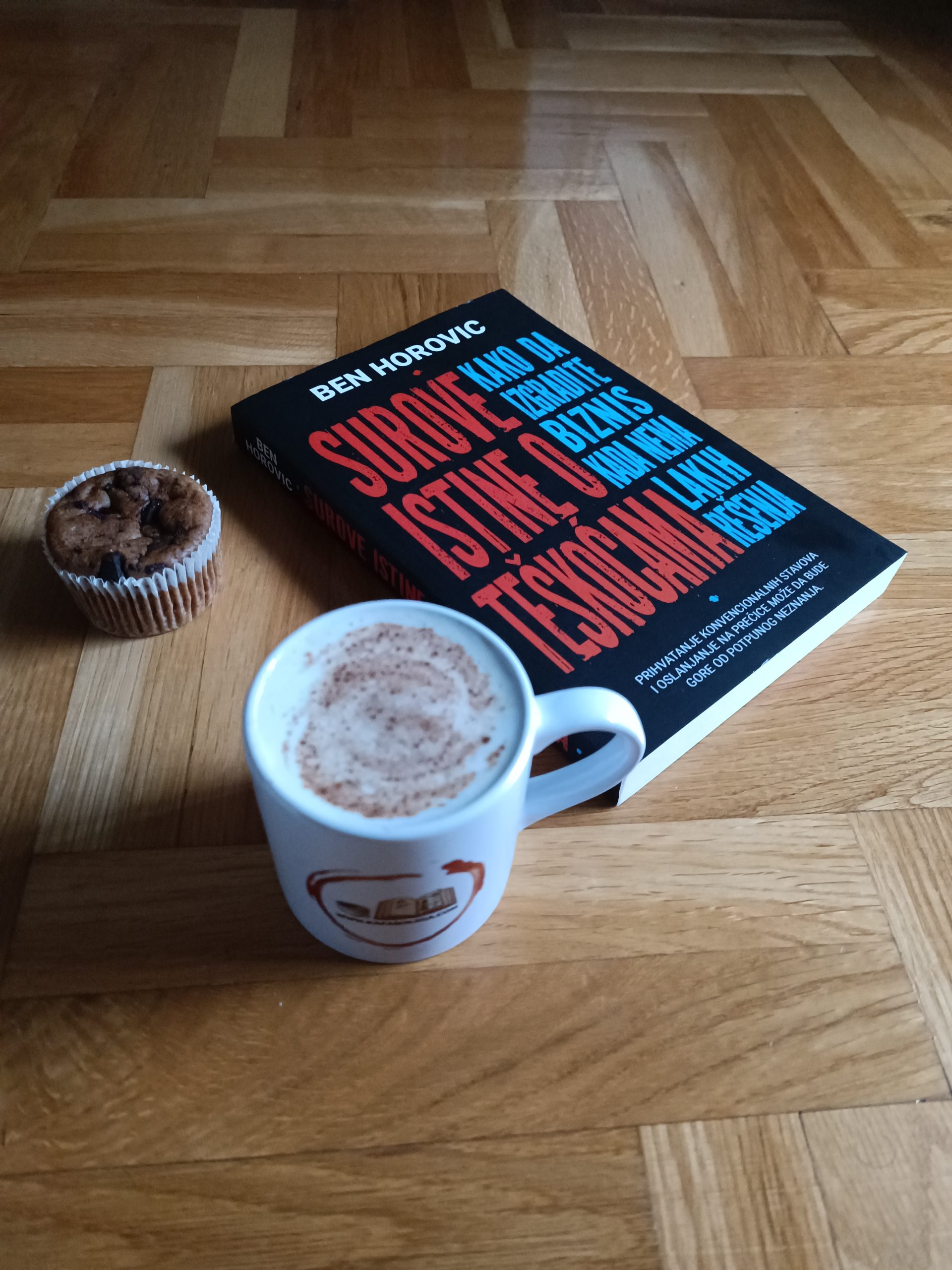
One interesting detail I particularly liked about the book “The Hard Thing About Hard Things” is that Ben during his career had quite a lot of contact with the legendary Bill Campbell, who often helped him with his advice and wise thoughts. And people didn’t call Bill the “trillion dollar coach” without reason, because he advised some of the most successful businessmen and innovators (and knew how to deal with their “quirks” and eccentricities).
Also interesting is that Ben is a great lover of rap music, so he emphasizes business lessons in this book with lyrics from his favorite rap songs.
The beauty of the book is in the fact that this (to quote sentences from the back of the book) “isn’t a victory lap run for applause; recalling his trials, Horowitz analyzes problems for which there are no easy solutions…,” as well as that “from many you’ll hear how wonderful it is to start a business, but only Ben Horowitz will brutally honestly describe how hard it is to run one.” Simply, this is a book oriented toward practice and challenges that a company can encounter, and especially a man who needs to lead a company (i.e., the CEO), and Ben will share those stories with us, without pulling punches.

And because of all that, this book absolutely deserves to be read. Hey, it ended up on my famous “shelf.”
And you, dear reader, what difficulties do you think a CEO encounters? 🙂
Author’s website | Book price: Harmonija Knjige | Vulkan | Delfi Ratings (and purchase) on foreign sites: Goodreads | Amazon | Bookdepository | Audible | Waterstones | Barnes & Noble