







Drive: The Surprising Truth About What Motivates Us
“Step by step… and you’ll get there. Just keep moving forward!” – BrankoS
Translating the book’s title simply as “Motivation” (in the original English: “Drive: The Surprising Truth About What Motivates Us”) could confuse you. From the title alone you might think “Here we go again… another book in a series on how to motivate me, blah blah blah, as if there aren’t enough books on that topic in the last 150 years.” Interestingly, although the book came out more than 10 years ago, it now has a somewhat “prophetic” note.
Many people criticized the book “Drive” for not (oh the irony!) motivating them too much to be motivated. By the way, when it comes to personal and professional development, many people have a large number of misconceptions about some things, but for the purpose of the book I’d mention two here:
1. People still live with the illusion that someone will pull them by the hand and give them 100% proven solutions to their problems, and if possible, solve them instead of them.
2. For many words and phrases, as concepts, people don’t know what they truly mean (e.g., if you asked people to explain to you what “motivation” is, they’d most likely give you a general answer that ultimately doesn’t even explain the essence of the word. Roughly, like if you asked me what “cheese” is, and I told you “it’s a food that’s tasty and goes great on a cracker with yogurt or on a burger. It can be from cows or goats. There are various kinds, gouda, trappist, mozzarella…” Roughly, you have an idea what it is, but I didn’t tell you anything very precise).
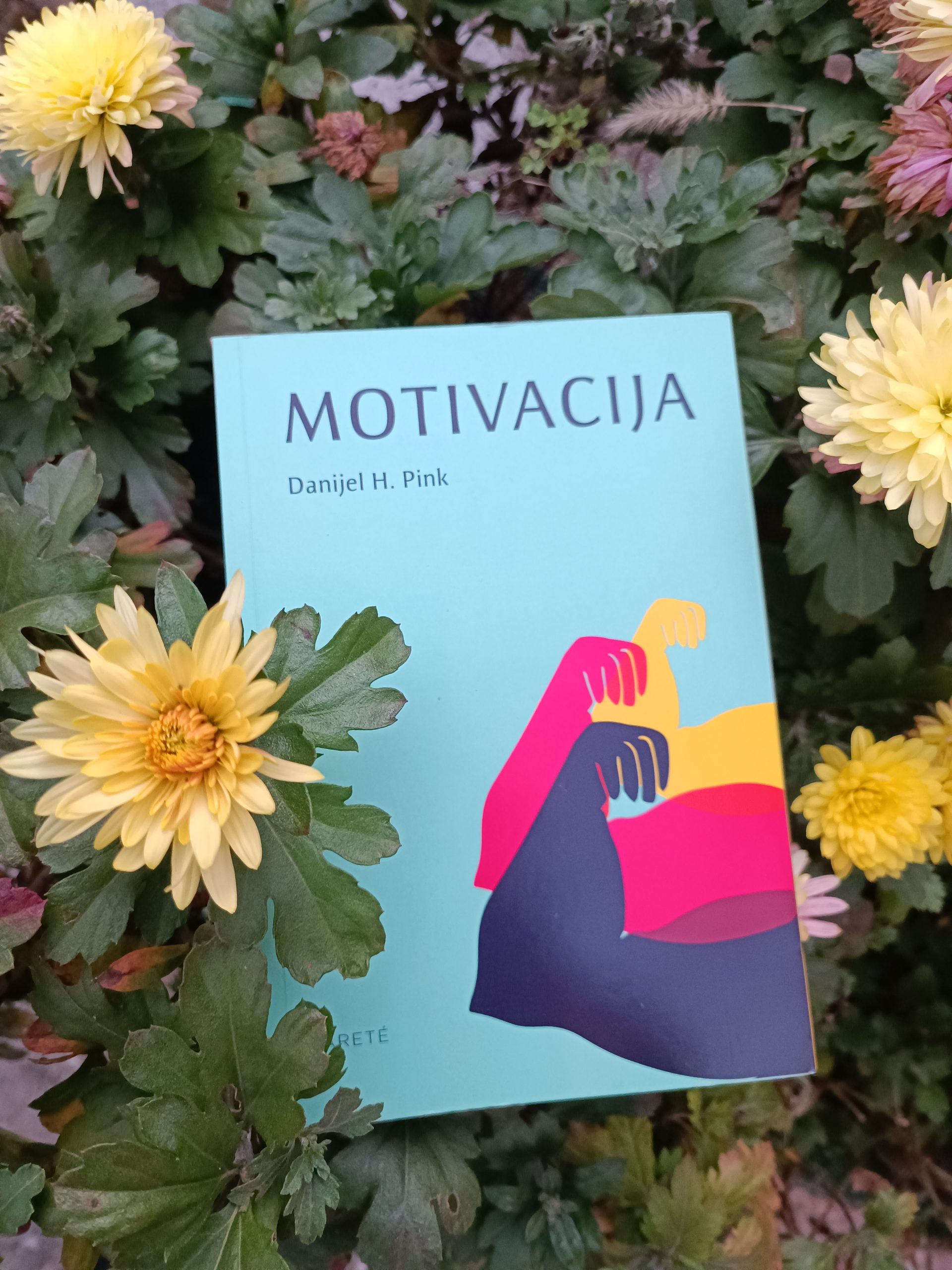
Although he’s not a psychologist, Daniel Pink didn’t fall from Mars. He’s the author of several shocking (thought-provoking) bestselling books, was a producer of a show that dealt with human behavior on “National Geographic” channel (“Crowd Control”), has guest-appeared on countless radio and TV shows, and his articles and essays have been published in many well-known (and professional) magazines (The New York Times, Harvard Business Review, The Atlantic, Slate). And before he turned to studying human behavior, the man worked in various positions in government and politics in general (e.g., he wrote speeches for Al Gore).
The essence of his book “Drive” isn’t so much a new idea as much as an upgraded and slightly more deeply researched one. And that is that the real motive for progress and effort doesn’t lie in external factors (extrinsic), but in internal ones (intrinsic). In translation, “external motivation” is receiving material reward (or avoiding punishment) in exchange for work done, while with “internal motivation” the work itself is the reward and brings some personal satisfaction.
Now, I think it’s necessary to IMMEDIATELY draw a line because of the logic of certain company owners, directors and managers, who might start reasoning “see, I’m nicely telling people it’s not all about my money, they should appreciate and love the work they do… because if they won’t, there are those who will and for less…” Daniel Pink is realistic here. His position is that employees should be fairly paid. Or better said, paid enough that money is no longer the decisive factor for staying at that workplace (to take the issue of money off the table). So the point isn’t a salary ten times greater than average (though that’s more than welcome, let’s not kid ourselves), but not the minimum either, but a sufficiently large/decent amount that the employee can focus on work.
The second important item is the type of work. Work that requires mechanical (either mental or physical) activity and/or routine cannot be inspiring (temporary bursts of inspiration or attempts at creativity with such tasks can only be short-lived) and the logic here is simple – a salary increase can lead to increased productivity (known in old Slavic as “you get what you pay for”).
However, with jobs that require thinking, creative thought, unique skills, setting aside time in search of a solution (as well as finding original solutions), it has been established that salary increases help up to a certain level of motivation… but subsequently (additionally) increasing material benefits can lead to a drop in employee motivation, because what happens? The primary focus becomes doing the job for (whatever) result, with reduced input of creativity and motivation for work, in order to get the money. Although the IT sector (especially compared to other sectors in all countries) is specific because of that aspect of earnings that can several times exceed the average salary, an interesting situation is observed there. For example, a programmer will, despite a good salary and benefits, after some time, leave the company due to absence of “challenges” and look for a new workplace. Or he might become an entrepreneur himself and develop his own product. Or he’ll simply have a nervous breakdown, buy a field on the outskirts of Valjevo and start growing organic potatoes and never return to Belgrade again.
The factor of that “internal motivation” is that the person is simply so interested and immersed in the task and finding a solution that they often enter the famous state of “flow.”

The book “Drive” is divided into three parts:
The New Operating System – Daniel Pink considers the system based only on (monetary) rewarding or punishing increasingly outdated, calls it “Motivation 2.0,” and that it’s necessary (especially for more creative jobs) to transition to “Motivation 3.0” which is guided by internal motivating factors of a person. However, he doesn’t take the position that “Motivation 2.0” should stop existing completely. The author will take us in the first chapter through the story of the creation of “Motivation 3.0,” but will also touch on “Motivation 2.0” in the sense of which situations it’s still useful in, and which ones it no longer is. Also, he’ll introduce us to the “Type I” and “Type X” categories of person (and systems), in relation to the type of motivation (the first is more evolutionary in line with “Motivation 3.0,” and the second is more static and old-school, in line with “Motivation 2.0”).
Three Elements – In this part, the author will touch on three elements that are relevant to “Motivation 3.0” and “Type I” person, in translation, what a person needs to be motivated and inspired for work. And those are autonomy (the desire to feel control over our life), mastery (the desire to get better and better at something that matters to us, to strive toward expertise) and purpose (in the sense of being in service of something greater than ourselves… and no, this doesn’t mean working for another’s interests until we drop dead). I think just from their names you can conclude how relevant these factors are for a person’s motivation… likewise, you can also see for yourselves that in the vast majority of cases companies don’t give their employees those possibilities, even those that claim they do.
Type I Toolkit – Although in some general forms they were mentioned in previous parts of the book, Daniel Pink in the last chapter laid out tools that encourage the “Type I” approach and are in line with the principles of “Motivation 3.0.” The proposed tools touch on how they can be (specifically) applied to both individuals and organizations, as well as to parents (or educators) or a fitness plan.

Now, although I plan to deal with this topic in the future on another website, I’d like to briefly touch on one detail mentioned in the book, which I’ve also been subtly advocating for a long time. What am I talking about? Let me quote the book a bit:
“Sometimes we forget that ‘management’ doesn’t come from nature. It’s not like a tree or a river. It’s more like a telephone or a bicycle. It’s something people invented.
…management is a technology and like Motivation 2.0, it’s obsolete technology. And while some companies have refreshed it, management at its core hasn’t changed much in a hundred years. Its central ethic is still control; its main tools are still external motivators… Is management, as currently constituted, at odds with human nature itself?
…Perhaps management doesn’t respond to our supposedly natural state of passive inertia. Perhaps management is one of the forces that changes our factory settings and causes that state.”
The reason I wanted to touch on this topic a bit lies in its timing. At the moment when I was writing the review, the largest world companies (especially from the sphere of information technology, automotive industry and fintech sector), after relaxing their employees (and not just those at the bottom of the hierarchy, but middle management too) at the outbreak of the pandemic, began aggressive hiring when the situation improved a bit, only to now come to laying off even more employees than before in attempts at consolidation (actually, cost-saving for 2023 and 2024, since their profit projections are currently very bleak). And in a very “humane” way… you just send an email that you won’t be coming to work tomorrow. No matter that a month ago they were throwing around terms like “company culture,” “employee care,” “Taco Tuesday,” “unlimited vacation,” “disruption” and so on…
Simply, although progress has been made in the sphere of technology, we still haven’t abandoned some old habits, we’ve simply “dressed them up” (or to use an old Slavic word, photoshopped them) and made them seem “fancy” and “modern.” Has there truly been visible drastic changes worthy of using the terms disruption or automation? If you ask top management, they’ll say there are enormous WOW changes, however, is that so if we “scratch the surface” a bit?
I think Daniel Pink is right.
We still have “Management 1.2.” We still have “HR 1.4.” And even company culture, although it’s been around for some time, could be “Company Culture 1.1.” And as for employee development and care, we’re at version “EP&C™ 0.3” (Employee Progress & Care… yes yes, it’s my coinage, sounds cool like the word EPIC and is meaningful, so if some HR/manager starts showing off with this term, rest assured they saw it here and have no idea what it exactly means, because I haven’t shared much on the topic of EP&C).
“Drive” is a book you can read (and analyze) from several perspectives, both as a director/manager/executive and as a “classic” employee (whether at the top or bottom of the hierarchy), and also as an entrepreneur. You can look at this book as someone who deals with art in some form (it’s nicely explained how “financial motivation” in combination with a deadline can often cause a drop in true motivation, and thus creativity. The artist will ultimately do the job, but won’t be as satisfied with the result of their work. This is, especially, a frequent situation for painters and writers). But likewise you can also view the book “Drive” through the eyes of an educator (if you fall into that rare category of educators who truly has the strength and will to resist the traditional educational system and wants to teach future generations to be capable and motivated for the struggle and navigation through life), but also a parent who wants to guide their child to acquire skills and enjoy the process of discovery and exploration, i.e., to stimulate them to improve throughout their life.
As I mentioned at the beginning, sometimes you first have to research (or at least remind yourself) what certain concepts truly mean and that how you interpret them doesn’t necessarily have anything to do with reality. I like to call that gb2b, i.e., going back to basics. Such is often the situation with motivation too. You must understand it, in order to know how to “activate” it. This isn’t some abstract book with empty talk. Research stands behind this book.
That’s why you should read this book. And especially if you want to be a leader somewhere in the future.
And you, my dear reader, how motivated are you to read this book? 😀
Author’s website | Book price: Arete | Vulkan | Delfi Ratings (and purchase) on foreign sites: Goodreads | Amazon | Bookdepository | Audible | Waterstones | Penguin Random House | Barnes & Noble