







Originals
Hmm… I have no idea how to review this book, which delighted and encouraged me in so many ways and is quite certainly (for me) one of the most pleasant surprises of 2020 (“Come on, and coronavirus wasn’t a surprise for you, you idio… ah, you wrote most pleasant, I just noticed, my bad…” – note from subconscious).
Adam Grant is a full professor at the prestigious Wharton School of Business (University of Pennsylvania). He’s a recognized research scientist and author of numerous works translated into many languages, so one might expect that his book “Originals” (“What an ‘original’ title…” – note from subconscious), despite its unusual title, would be dry and boring. But if many consider this professor and scientist a great expert in the field of interpersonal relations, then that’s a different story, right? 🙂
Who are these original people with original ideas? Where to find them and how to recognize them? Maybe they’re all around us, we just don’t know how to notice them? Maybe an original person is someone who has an unusual yet simple idea, like reviewing books and films, exploring cafés and helping people (“Uuugh, for God’s sake… excuse me, I’m going to go ‘drop the iron,’ I can’t believe he wrote this” – note from subconscious).
Joking aside, how do these original people appear in business, sports, science or politics? Or maybe it’s better to ask “when” they appear?
Through his interesting research and analysis of famous (and successful) companies, businessmen, speakers, artists and revolutionaries, Adam Grant tries to take us through the story of how to recognize an original idea. And he’ll also show us how some original ideas, in the end, aren’t as revolutionary as their creators believed.
The book reveals many interesting facts through both historical events and statistics.
You know how they (often) tell us that if we have a brilliant idea (and we want to be entrepreneurs), we must put all our eggs in one basket and fight to the end? Victory or defeat! Take risks! However, what if you change your approach and take moderate risks? What if you’re ready to do everything to achieve your dream, but not sacrifice everything? You’re not ready to quit your job to pursue your dream? People would probably tell you that you don’t believe in yourself and your original idea, right? But is having a backup plan a sign of insecurity… or of possessing tactics and a cool head? Do you think Bill Gates, John Legend, or Warby Parker became what they are by sacrificing everything? Think again.
Is an original product the first one (“pioneers”) or perhaps the one that built upon the original idea and created something that’s both revolutionary and useful (“settlers”)? What do you think, how many people have heard of the Magnavox Odyssey, and how many of the Nintendo Entertainment System?
Maybe, to push your original idea through, you also need to have some kind of power, position and experience to be heard, as was the case with Carmen Medina?
Maybe procrastinating on realizing an idea can be precisely that “X factor”? Maybe that “X” is a reworked idea, more thorough research and better consultations… or maybe just letting some time pass? Steve Jobs was a visionary, but he didn’t assess Segway well because he didn’t know that market. The series “Seinfeld” wasn’t immediately accepted and at first people thought the very idea of the series was lame, but over time it became a megahit.
Martin Luther King didn’t just stand at the podium and start with the famous (and original) “I have a dream,” but that was led to by experience accumulated through a hundred speeches, dealing with pressure and fears, and even completely changing entire speeches the night before important events!?

And with everything written so far, I’ve only scratched the surface of the story…
As I mentioned, it wasn’t easy for me to start reviewing this book. Moreover, even my relationship with this book was, to say the least, strange (although I’m thrilled with the book itself). Sometimes I would read only a few pages, I would often go back to read some passages again, make mental notes, and sometimes I’d forget where I stopped reading!? 😀 Well, I “dragged out” the book for two whole weeks! But again, the moment I finished reading it, I knew I’d soon have to read it again. Simply put, I think this is one of those books that needs to “settle” with you.
Why is that?
I don’t know about you, but for me this book had some kind of… well… I don’t even know what expression to use… “reflective” effect? While reading “Originals,” you’ll notice that all the research and (percentage) statistics seem somewhat contradictory. Like a pile of (contradictory) questions I wrote in the previous paragraphs. But that’s also something encouraging! “Originals” shows that there’s no template for success, as many Insta(gram) entrepreneurs convince us. Everything is individual and you shouldn’t do everything the way others convince you. This is one of the (scientific) books that encourages you to follow your own path, your own assessment of situations, as well as the moments when you should act.
You’ve always been of a cautious nature and liked to first explore all options, and it worked well for you? Now you want to start some side hustle and slowly develop it, and someone’s convincing you that you must go aggressively, “all or nothing” if you want to succeed, because that’s what they did? Unless you’re of similar (life) qualities, mentality, or in a similar type of business, you’re really not obliged to listen to that person or think they know best, especially since things are currently going well for them. Polaroid and Nokia were masters of the world in their industries at one point, living in the belief they were the smartest and best. And where are they now?
The most important thing is to always be open-minded to potential changes.
And I think this is where the greatest values of this book lie. First, it will make you turn your brain on again. And second, it will encourage you to (if you aren’t or have forgotten) be more receptive to new ideas and positive constructive criticism.
I especially liked one position in the book, of which I’m a fervent supporter myself, and it concerns company/corporate culture. Namely, a large number of companies have the attitude that a potential employee must align to a large percentage with the company’s attitudes/beliefs. As much as this contributes to coherence and unity in the company, on the other hand it can also lead to groupthink which in many companies often borders on cult-like behavior (and for quite a few companies this has been a reason for their downfall). You (as a company) don’t just need like-minded people (you’re not a political party) to strengthen your company culture, but also people who will improve it! And that can be someone who just started working for you. For example, a large number of companies focus (and quite unsuccessfully) on exit interviews. And why wouldn’t they try to see how an “entry interview” works. Ask the newly hired how they experience the company, and whether perhaps something seems illogical or unusual to them. You hire fresh, young blood to improve things, not just to replace employees who moved to another company or retired.

And that’s why it’s good to find a…
…”devil’s advocate.” But not a quasi-version of one, but one who’s truly honest and has the best intention to find flaws (or, if you prefer a more optimistic expression, “challenges” :)) for you/your company. It’s better for your employee to point out problems than for the competition to “figure them out” and use them against you.
I believe you’ll find the part of the book about Ray Dalio and his Bridgewater interesting too. Dalio’s principles aren’t empty words, but something that can be “challenged” (challenge the principles). And not just them, but Dalio himself. I assume Bridgewater isn’t so successful and popular among its employees without reason.
A boss who possesses great knowledge, authority and self-confidence, but a small Ego, is a strong leader and good ally, right?
The chapter about how moderate pessimism can be useful for some people will also be interesting, and how, for some people, channeling fear into tension and anticipation can be stronger “fuel” for progress than forced optimism.
And you’ll be intrigued by the idea that the majority (which is often achieved through manipulation) doesn’t always have to be right, but that a qualitative minority might be better, which will make you think about Ray Dalio’s thought:
“Democratic decision-making – one man, one vote – is stupid, since not everyone has the same credibility.”
A pretty controversial statement, right? How can he say that, we’re all the same human beings, we all have the same rights… and yet, in our world where we should all have the same rights, we don’t all have the same salaries (even people working in the same/similar positions often have different salaries), we don’t have the same level of education… and we also live in a world of racial, religious and moral discrimination.
Well, it’s not worth going much deeper into this topic. It’s not democracy that has failed us, but we’ve probably failed it, so now the world is ruled by “democracy of quantity” and groupthink, not “democracy of quality and debates for the purpose of improvement.”
Something is “broken” – people or the system. Who knows what…
And another part that will be interesting is how much Adam Grant devoted space in the book to Srdja Popovic and the “Otpor” group from the perspective of inspiring people to act through different (creative-psychological) actions.
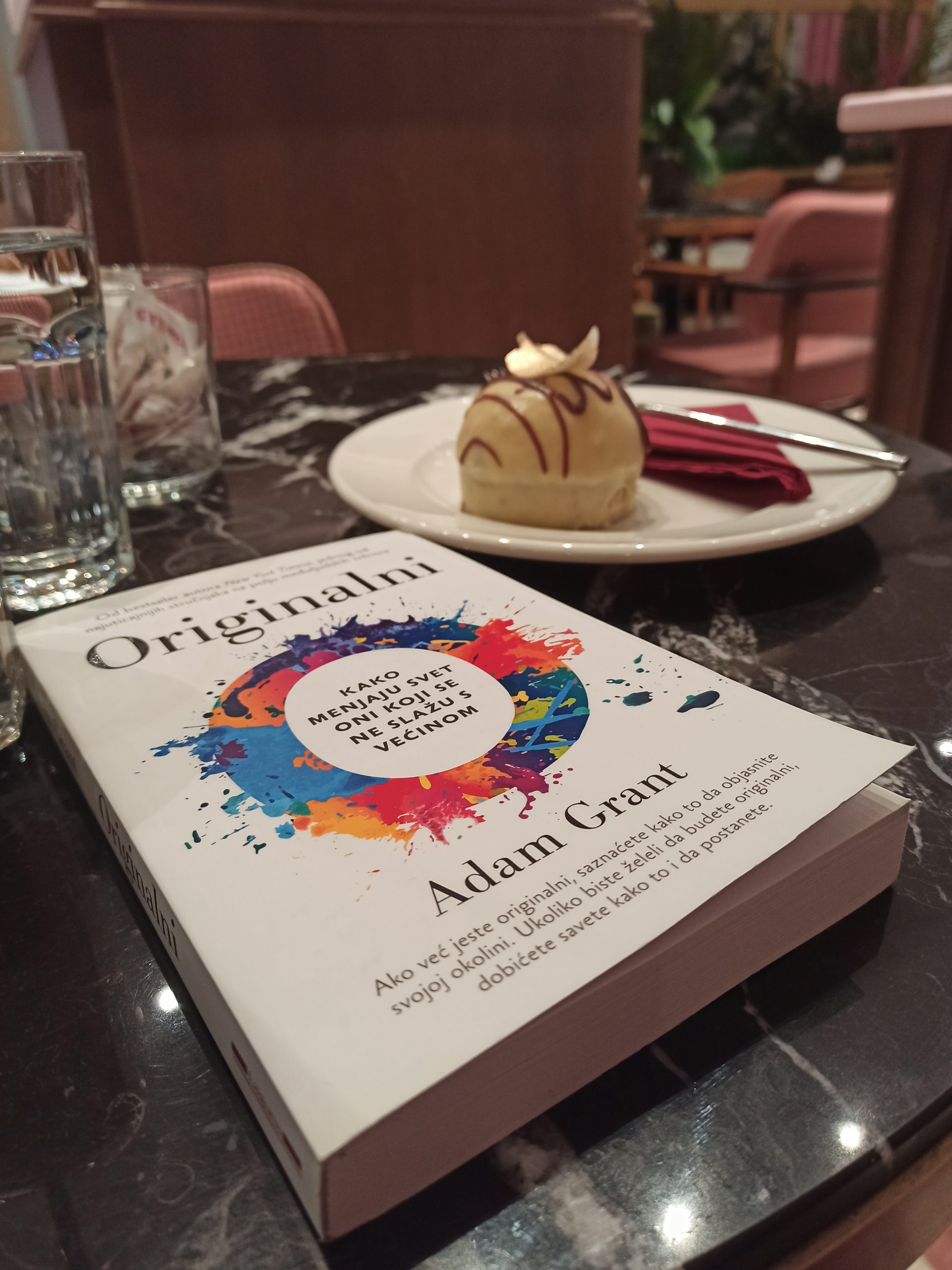
At the end of the book, you’ll find a summary of what useful actions you should take:
Actions for individuals:
- Question the default
- Triple the number of ideas you generate
- Immerse yourself in a new domain
- Procrastinate strategically
- Seek more feedback from peers
- Balance your risk portfolio
- Highlight reasons not to support your idea
- Make your ideas more familiar
- Speak to a different audience
- Be a tempered radical
- Motivate yourself differently when you’re committed versus uncertain
- Don’t try to calm down
- Focus on the victim, not the perpetrator
- Realize you’re not alone
- Remember that if you don’t take initiative, the status quo will persist
Actions for leaders:
- Run an innovation tournament
- Picture yourself as the enemy
- Invite employees from different functions and levels to pitch ideas
- Hold an opposite day
- Ban the words like, love, and hate
- Hire on cultural contribution, not cultural fit
- Shift from exit interviews to entry interviews
- Ask for problems, not solutions
- Stop assigning devil’s advocates and start unearthing them
- Welcome criticism
Actions for parents and teachers:
- Ask children what their role models would do
- Link good behavior to moral character
- Explain how bad behavior hurts others
- Emphasize values over rules
- Create novel niches for children to pursue
As I mentioned, this review wasn’t easy. The book “Originals” is a work that must be read again. Interesting events and (percentage) statistics will make you reexamine yourself a bit and perhaps bring you back on track and reignite in you the passion to persevere. 🙂
Definitely one of the better books I’ve read in the last couple of years, to which I’ll definitely return often and which deservedly goes on my “Shelf.”

And you, dear reader, do you also belong to the “originals”? 🙂
Adam Grant’s website
Book price: Delfi | Laguna | Vulkan
Ratings (and purchase) on foreign sites: Goodreads | Amazon | Bookdepository | Audible | Waterstones | Penguin Random House