




Battle Royale
“A student is not a mandarin” – Kinpachi Sakamoto
There’s a probability one part of people aren’t familiar with the term battle royale.
For many today this term is probably known because of video games like “PUBG,” “Fortnite” or “Apex Legends.” For some it’s probably known because of the eponymous cult Japanese film from 2000. An even smaller number of people probably know the film was made based on the novel we’ll address here. And the smallest number of people probably know battle royale is a term originating from one type of match in boxing or wrestling, where a larger number of fighters fight by one against all rules, to the last fighter. Takami Koushun was interested in the social aspect of such matches, because one of the important elements related to battle royale is the situation where fighters can (temporarily) unite to defeat a stronger opponent. This can lead to situations where bitter rivals can become temporary allies in battle against a third (stronger) person, but must also be on alert for potential (but inevitable) betrayal from current ally. In translation this resembles medieval court intrigues (as well as modern) political situations where “knife in the back,” however dishonorable, was quite a legitimate strategic move.
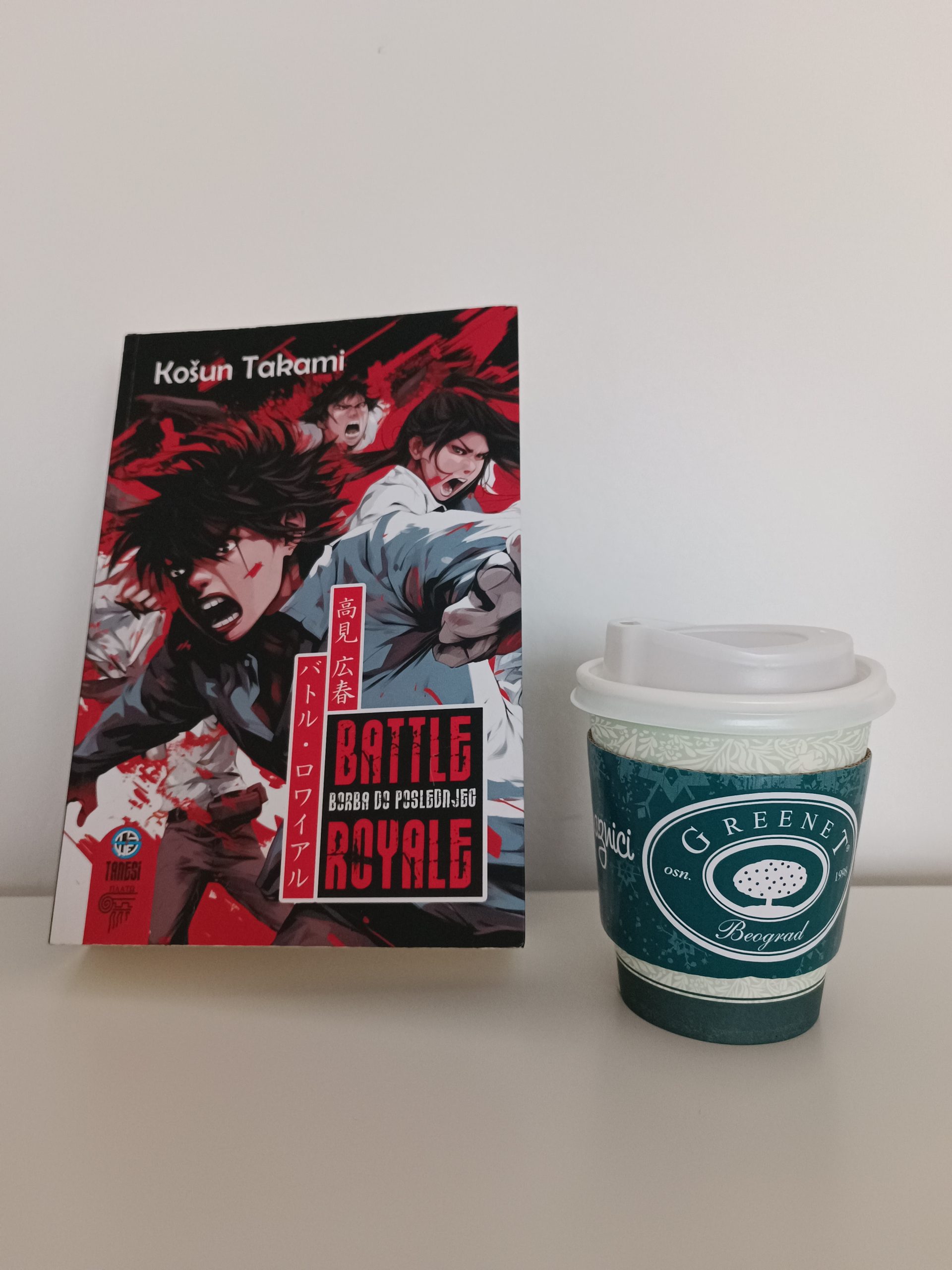
Now, since we’ve (hopefully) clarified this term, let’s turn to the book “Battle Royale” (translated here also as “Fight to the Last,” but we’ll keep the original title here).
Let’s imagine a scenario where Japan was one of the winners in World War II and the state Republic of Greater East Asia was created, where a fascist totalitarian regime rules, combined with isolationist policy. To keep the people under control and prevent potential future population rebellions, the state executes one demonstration exercise every year, aiming to discourage people and drive them to submission. Namely, every year one class is chosen from all middle schools in Japan. That class is, factually, kidnapped (apparently most often when they go on some trip) and transferred to one of the small Japanese islands (which is previously evacuated). The confused students of that class get only one task.
To kill each other however they know and can. Yes, you read that correctly.
Only at the end can one student be the winner, and they, supposedly, are then awaited by great popularity and fame, i.e., become something like a celebrity (or to draw parallel with today’s Japan, some kind of teen idol).
Each student (besides the backpack they brought on the trip, if they even brought one), also gets one backpack from the army. In that backpack are a bottle of water and a little bread, island map (more on this soon) and one random weapon (or some tactical item). Yes, you read that correctly. As for weapons, you can get anything, from penknife, baseball bat and crossbow, to pistol, uzi or machine gun… or maybe you get a helmet or armor or something similar.
The map serves so you’d know in which island zone you are. Why is this important? Well because (if I remember correctly), every eight hours one zone/area of the island becomes forbidden (which is announced throughout the island every day), and if by chance you stay even a second longer in a zone becoming forbidden… well, your head will literally explode. Yes, you read this correctly too.
Each student has around their neck a tightly fastened metal collar that detects who is which student. And if a student stays even a second longer in forbidden zone, head explodes. Tries to remove collar forcibly, head explodes. Tries to deactivate collar, head explodes. In translation, in this “game” your head easily goes.
By the way, the evacuated island where the “game” would take place isn’t just abandoned, because there is, after all, a settlement, which means there’s probability you can find some additional food, weapons, and even medicine, and maybe even some still functional vehicle.
And how you’ll play the “game,” solo or in alliance (if there are interested), that’s up to you. As long as you’re aware only one can remain in the end. So you won’t sleep peacefully in any case, but always be on alert.
The “game” rules are clear, right?
The unlucky class in the book “Battle Royale” is class B, third year in Shiroiwa Middle School. Everything I described earlier happened to them. Sudden abduction, transfer to island, “meeting” in abandoned school with group of soldiers led by sadistic instructor/supervisor (named Kinpachi Sakamoto), introduction to game rules, preventing rebellion (bullet in forehead to one of the students easily solved that)… and now our unlucky heroes in exactly defined time intervals one by one leave school…
…and the “game” begins…
…and already the first day there are many dead… and all died in the most brutal possible ways.
Though we’ll in “Battle Royale” go through actions (as well as mental state and thoughts) of each student, some stars and “stars” will soon stand out:
- Shuya Nanahara – left without parents as a child and later placed in orphanage, this good-natured pacifist (and former talented athlete) is, after all, a rebel against the regime, which he especially emphasizes through adoration of rock music (which is forbidden in the country). He’s disgusted by the “game” idea and thinks as many of his classmates as possible should unite and try to find a solution so almost the entire class doesn’t perish
- Noriko Nakagawa – quiet and modest girl full of patience and wisdom, experienced the misfortune of being shot in the leg relatively early at the “game’s” beginning. She teams up with Shuya in whom she has absolute trust and who does everything to protect her. On the other hand, Noriko seems to keep Shuya of sound mind with her wise words
- Shogo Kawada – loner, who was transferred to this class two months before the “game” began, and who with his appearance and attitude didn’t exactly instill too much trust in others in class. Though cautious, Shuya and Noriko team up with him at one point. However, Shogo is quite an enigma for these two, which brings discomfort to them, because Shogo somehow seems too calm and rational in this “game” and thinks very strategically and doesn’t allow emotions to shake him, and apparently for some reason knows quite a bit about the “game’s” background
- Kazuo Kiriyama – though he experienced brain injury still in womb, he grew up into a very attractive genius. He simply can intuitively grasp everything and learn faster than most people (from playing violin to martial arts), but as soon as he masters something, it immediately bores him and he drops it. There’s only one problem… the guy is a sociopath and gang member, however, point two isn’t as problematic as point one. Namely, due to brain injury, he’s unable to feel emotions. And now you have one fearless and very intelligent sociopath who cracked, well, to play the “game” after all
- Mitsuko Souma – incredibly beautiful and attractive girl, who’s all cute and seductive on the outside, but is only a “shell” inside because of traumas (sexual abuse among other things) and she doesn’t trust people at all and doesn’t hesitate to use all her skills (including sexual) to get what she wants. Her smile is said to be the true embodiment of “fallen angel’s smile.” Because of everything that happened to her, she has quite a twisted view of human relationships and is convinced with sex’s help she can get everything she desires
- Hiroki Sugimura – at first glance reserved and withdrawn, this brave guy spends the entire “game” to find one specific student. Though he didn’t socialize much with others in class, everyone agrees that, when they get to know Hiroki better, he’s actually a very good guy
- Shinji Mimura – very talented basketball player, who got the nickname “Third Man.” Shinji is without doubt one of the smartest in class. Using his surprisingly wide (life) knowledge, mature worldview and access to some information outside Republic of Greater East Asia, Shinji tries by all means to outsmart the “game” and Sakamoto, starting from trying to hack government server to better understanding the collar’s functioning around neck
And so we follow our heroes and “heroes” in this very tense “game” (of cat and mouse).
Keep in mind “Battle Royale,” despite participants being middle schoolers, is a very serious novel. It addresses a dystopian (but not impossible) world in which one of the great powers keeps its people in obedience with its fascist and totalitarian regime, meanwhile conducting isolationist policy (this reminded me a bit of the “Legend” tetralogy by Marie Lu). Most of the population is aware they have no benefit at all from such a regime (and some of the middle schoolers participating in the “game” will often think or talk with someone about this), but also that the state system is made so it’s hard even to start any revolution.
Of course, one of the novel’s important motifs is also how far you’re willing to go when your life is threatened and whether you’re still led by moral compass then or not, as well as what happens in your head then. The writer nicely conveyed through students people’s diversity, their psychological structures, as well as how (extra)family environment shapes us. Of course, almost all students are frightened and clearly make it known they in principle can’t completely trust anyone, because the question is how well they really know their society, even those with whom they grew up and were best friends.
Some will be willing to risk and (at least temporarily) unite in smaller groups, some eventually in tandem, and the largest number will remain solo player. Some will be mentally strong enough to keep (more or less) clear head and cold-bloodedness, and some will quickly get discouraged and accept fate. But likewise, some will literally psychologically “crack” and become paranoid or drift into some fantasy world of their own so they don’t completely “go crazy.” And unfortunately, some will also agree to (sadistically) enjoy this “game” a bit… because when you look, how often are you given the chance to kill and not bear consequences…
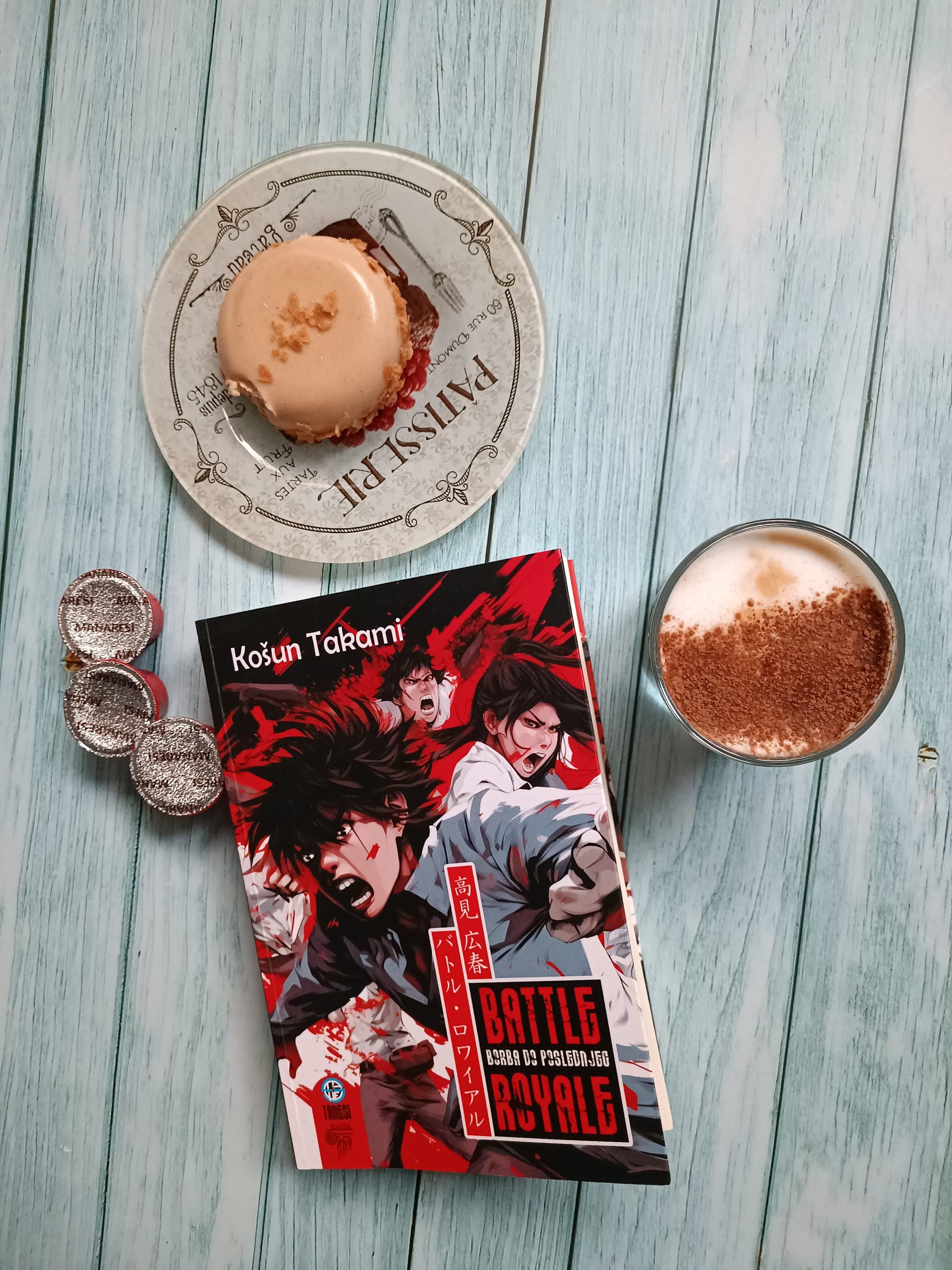
Of course, the question will also arise whether you’re willing to just kill your best friend or crush.
“Battle Royale” is quite bloody and harsh novel. The writer didn’t spare on details, so you’ll often see graphic descriptions of individual students’ death scenes, as well as how their conflicts unfolded, so you need to be aware of this novel element too.
Because of everything mentioned, this novel is often defined as dystopian horror novel (there aren’t necessarily aliens or some creatures, but it’ll be clear to you why it’s in this category while you read).
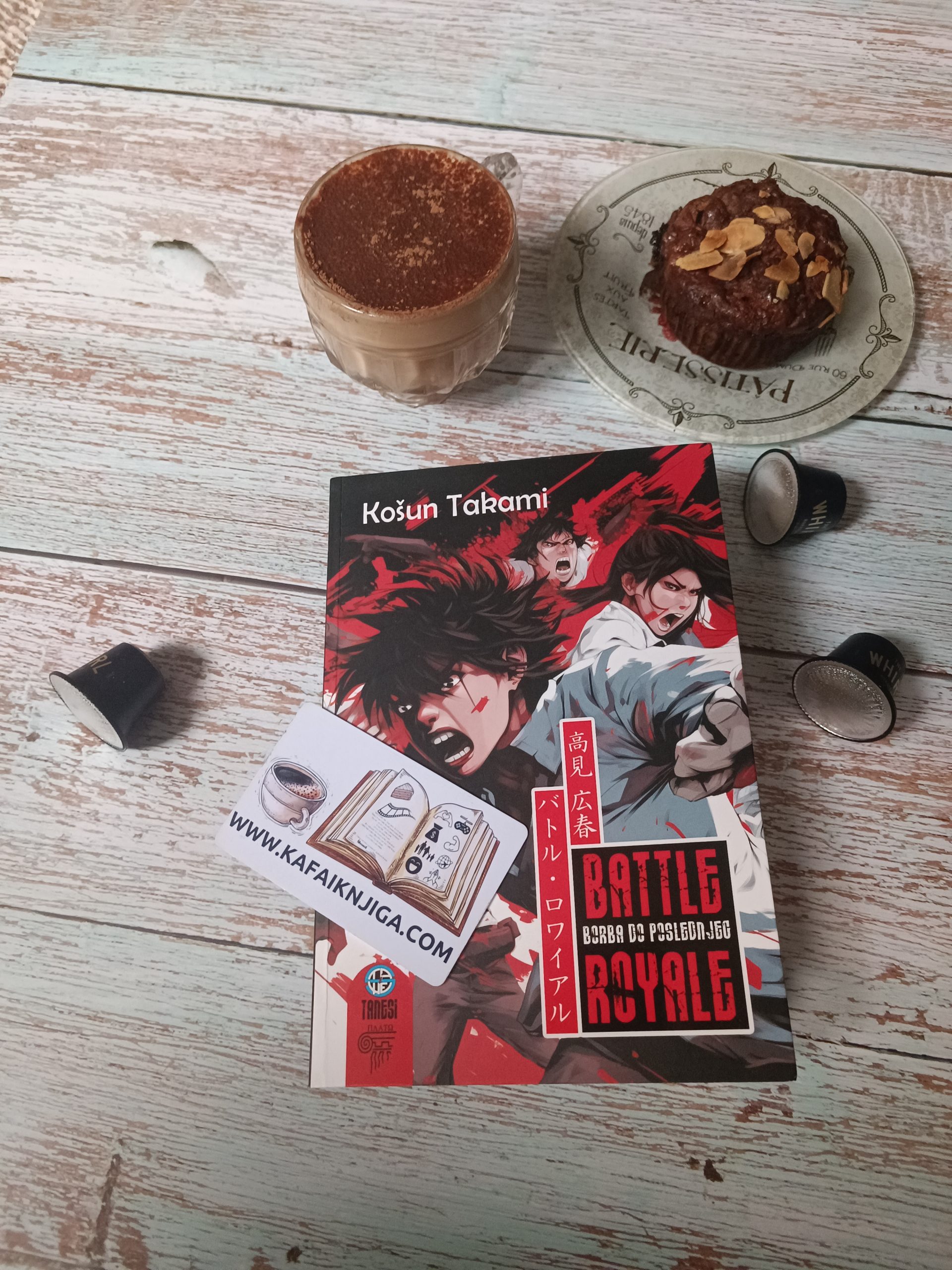
Though writer/journalist Koushun Takami finished the novel in 1996, it wasn’t published until 1999. It was proposed for Japanese Horror Fiction Award in 1997, but was rejected in the final round because there was concern about the subject matter and how it would be received by readers. However, upon publication, it became a bestseller, spawned the eponymous Japanese cult film (and somewhat weaker sequel), but exerted greatest influence, as I mentioned earlier, on the video game world (for whose aforementioned titles you’ve surely heard even if you’re not in the video game world because of their huge popularity).
All in all, “Battle Royale” is a classic that should be read. The book reads quite quickly (and there’s plenty to read, because it has almost 540 pages) and is written (and translated) in simple style.
The subject matter is serious, dark, bloody and (politically) touchy, so it’s no surprise Hollywood (or Netflix/Amazon) still hasn’t dared to do a Western adaptation of this work. But you never know.
Recommendation from me!
Dear reader, have you had the chance to hear about the term battle royale? 🙂
Book price: Delfi | Makart | Vulkan | Dereta
Rating (and purchase on foreign sites): Goodreads | Amazon (US)