






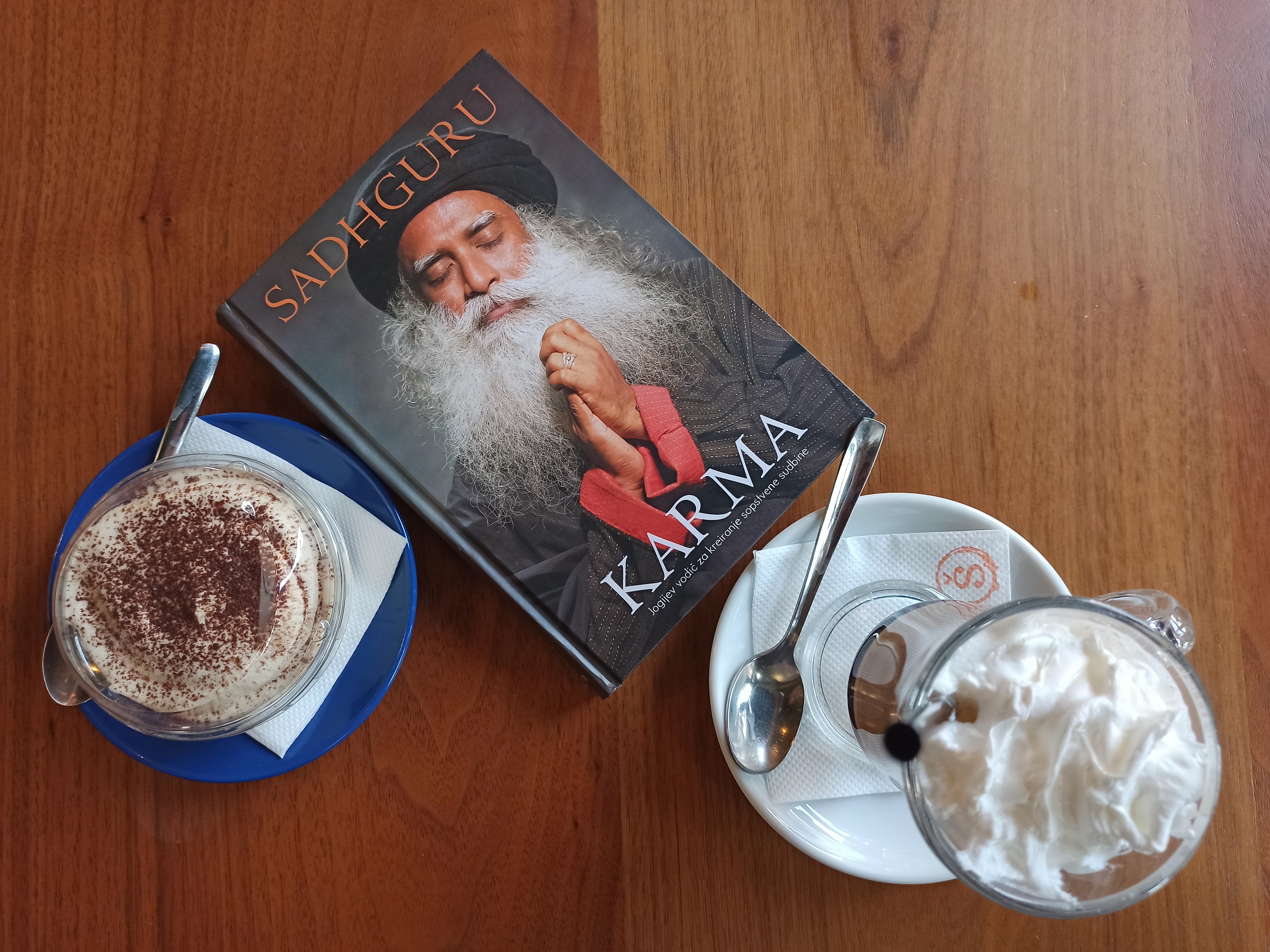
Karma
The desire (and action) to defeat, overcome myself and my weaknesses, constant improvement and continuous reading… and on top of all that the will to be “open-minded,” led to the fact that I can “challenge” some things and concepts/dogmas/beliefs for the sake of a better life. I’m very spiritual (but very, very, very moderately religious), and when it comes to the spiritual aspect of life, I’ve explored everything from shamanism to Taoism.
However, one concept has always been a challenge for me, with which I could hardly find common ground… and that’s karma.
For someone who questions everything under the sun, for some reason, regarding karma I always had a (mildly defeatist) attitude… shrugging my shoulders with a comment about some (bad) things happening to me, “that’s obviously my karma, probably something from past lives…”
Justification for actions or not? I was never sure when it comes to karma, although I read a lot about it and asked people who deal with it… but those concepts of karma from Buddhism, Taoism, and Hinduism didn’t really encourage me…
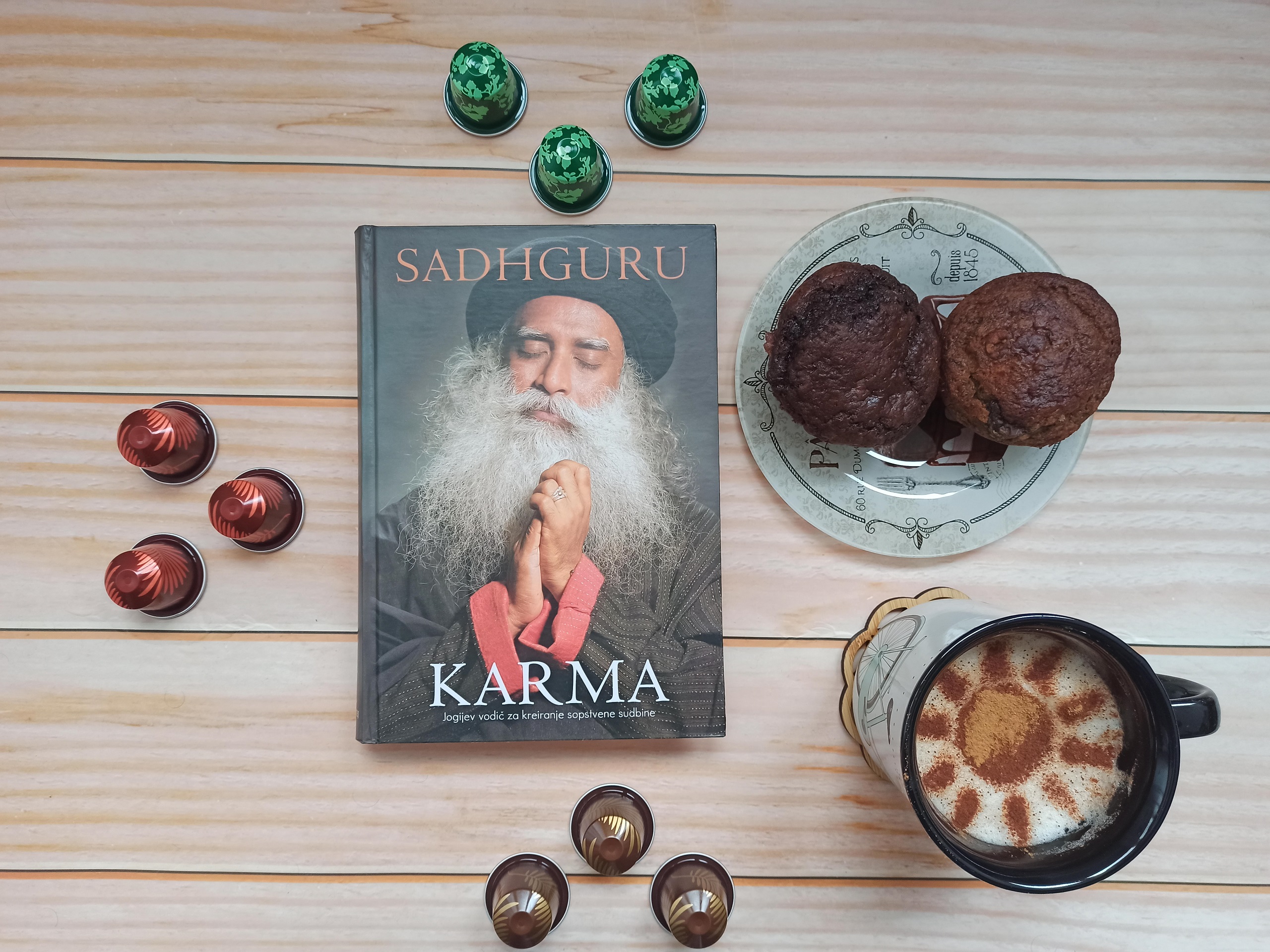
…until I started reading Sadhguru. I started with the book “Karma.” I simply picked it up without thinking when I saw it. I hadn’t listened to Sadhguru much before, nor did I know what the book was about (I assumed it was, logically, something about karma… I’m not that dumb :D).
And then comes this yogi and mystic named Sadhguru. Imagine sitting at a river confluence, lost in thought. And suddenly you sigh aloud with the comment “ah, if only I understood karma better and what it’s doing to my life, maybe I could move forward.” Suddenly you hear the sound of a Harley behind you and suddenly next to you sits some bearded man with a turban, dusty shirt and worn jeans, sandals on his feet and all, and he looks at you with eyes full of understanding. Of course, your first reaction would be to move away, blow a whistle, prepare pepper spray, look if there’s a patrol nearby or if you still remember your self-defense course. However, this bearded man suddenly opens a can of beer, burps loudly, farts even louder and says “Karma is about becoming the source of your own creation. By shifting responsibility from the heavens to yourself, man himself becomes the creator of his own destiny,” and then hands you a business card that reads “Sadhguru: yogi, mystic, recipient of three presidential awards, founder of Isha Foundation. Net worth: 25 million dollars.”
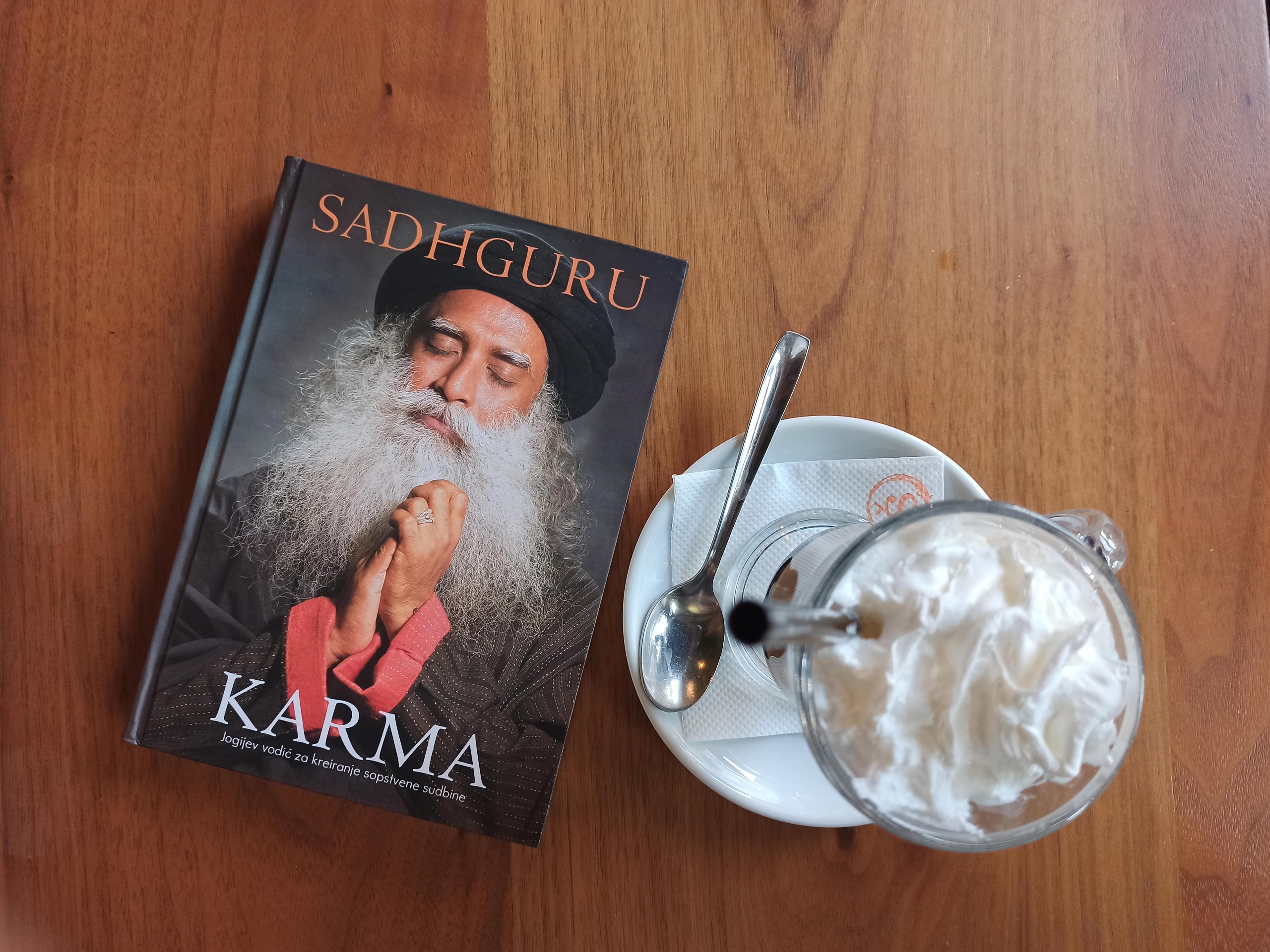
Of course, what I wrote about Sadhguru has nothing to do with reality (though the man really does ride a motorcycle and the data from the fictional business card is accurate), but the indisputable fact is that his explanation of karma (what it is, how it functions, our influence on it, etc.) is incredibly simple, written so that even a person who hasn’t had prior contact with the concept of karma can understand it.
“Karma” is divided into nine chapters:
- Karma: The Eternal Riddle
- Will: The Basis of Karma
- Karma as Memory
- The Great Karmic Warehouse
- How Did It All Begin?
- Karma Yoga
- Karma Yoga and the Physical Body
- Karma Yoga and the Mental Body
- Karma Yoga and the Energy Body

Why is Sadhguru’s “Karma” a book that “gets” you from the start? Because it doesn’t matter whether you’re interested in the concept of karma from a philosophical or practical/pragmatic aspect of applicability. It doesn’t matter whether you’re an expert on karma or encountering it for the first time and are a complete layman. It doesn’t matter whether you know all aspects of yoga or thought yoga was a cocktail. This book addresses everyone.
The book has quite a calming effect on the reader. It’s there to encourage you, comfort you, educate you… but also to make it clear to you that karma (for the most part) depends on you. As it says in the book:
“If the wheel keeps breaking your foot over and over, the problem isn’t the wheel. The problem is that you don’t know how to steer the wheel.”
Right at the beginning of the book, Sadhguru engages in demystifying karma, and in a very simple and logical way.
What is karma? Literally, the word means action.
Karma has nothing to do with reward and punishment.
Karma simply means that we created the blueprint for our own lives. It means we ourselves are the creators of our own destiny. When we say: “This is my karma,” we’re actually saying: “I am responsible for my own life.”
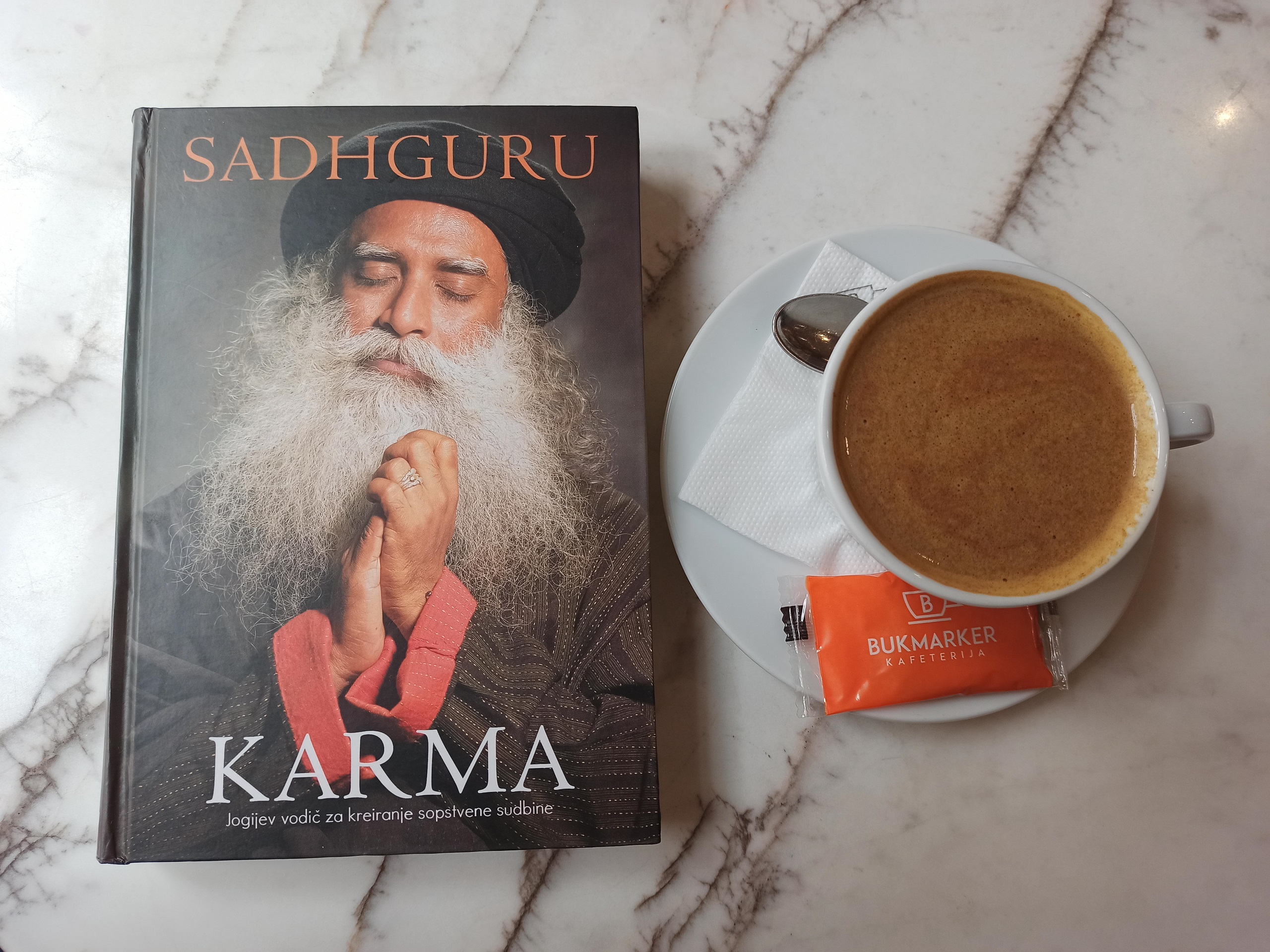
Karma is not a doctrine.
These are just some of the thoughts you’ll encounter in this book. To be fair, many won’t like reading such sentences and will certainly dispute them. Because no one likes the idea that we are (for the most part) responsible for our life. It’s easier to shift most of the blame to some “higher power,” isn’t it?
Are you burdened (as I was for years) with the search for meaning? And then comes a yogi and says: “That’s why I constantly tell people around me: Don’t search for anything. Don’t search for the meaning of life. Don’t search for God. Just look, and that’s all. That’s the basic quality of a spiritual seeker, because life is in seeing what is, not what you want to see.”
Do you constantly (excessively) think (overthinking)? Watch this: “If you look at most intellectuals in this world, you’ll see they’ve become overburdened with memory. I carry much more memory than most others, but I’m not burdened by it, because I carry my karma at a distance from myself. I can access it when I need it, but I don’t carry the burden on myself all the time. With practice, everyone is capable of that. It’s similar to the ‘cloud’ where we now keep computer files – they’re available to us as needed, but don’t bother us on the hard drive. So I have access to memories of entire lifetimes, but it’s all in the ‘cloud’.”
Strong words, you’ll agree.
You literally have the feeling that Sadhguru has an answer for every personality type.
That’s why I had a marker with me the whole time and underlined certain sentences and passages. “Karma” is a book you’ll occasionally return to flip through, you’ll be convinced of that. I took a “break” from the initial reading, and plan in the near future to flip through again those parts I underlined.
“Karma” is, in fact, an incredibly simple and practical book. Although it has quite a few profound parts and terminology (but every term is explained, so you don’t need any prior knowledge for this “field”), you’ll be surprised how much practical guidance there is, not so much for “physical action,” as for “mental action,” i.e., for changing the approach in the way of thinking.
The book is full of instructive anecdotes and teachings (the hero of many mentioned comical and instructive situations is Shankaran Pillai, who is a fictional character with whom every person can connect… like Nasrudin Hodja in our region, or Perica/Mujo/Haso in jokes).

At the end of many chapters you’ll encounter what we could call “spiritual practices” (sadhana – tool/device)… which in a way could fall under the aforementioned “mental actions,” more focused on practical tasks for your mind.
And if some term isn’t clear to you (or you’ve forgotten what it means), you have a glossary of terms at the end of the book.
All in all, Sadhguru’s “Karma” is an excellent book, and for me it “opened my eyes” to many things regarding karma and the principles that stand behind it.
Interestingly, this book is excellently rated on many sites (including the always harsh Goodreads)… and that says something.
Summa summarum, everything (for the most part) comes down to personal responsibility.
“The Witcher” summed it up nicely: “There is no good and evil – only choices and their consequences.”
At the first opportunity I’ll pick up Sadhguru’s “Inner Engineering” to read. 🙂
And you, dear reader, who’s driving “your car called life”? 🙂
Sadhguru’s official website and his foundation
Sadhguru (Instagram)
Sadhguru (Serbian YouTube channel)
Book price: Prometej | Delfi | Esotheria
Ratings (and purchase) on foreign sites: Goodreads | Amazon | Bookdepository | Audible | LibraryThing | Waterstones