




- “Brave New World” depicts a World State in which people are produced in bottles, assigned to castes in advance and kept happy with drugs, endless entertainment and consumption (no beatings, camps or secret police)
- Through Bernard Marx and John the Savage, author Aldous Huxley asks whether stability is worth giving up freedom, art, truth and real love… and whether a person has the right to be unhappy
- The opening feels like a lecture, and the characters are sometimes more ideas than people, but the vision is more relevant today than it was in 1932, and the book is required reading alongside “Animal Farm”, “1984” and “Fahrenheit 451”
“Technological progress has merely provided us with more efficient means for going backwards” – Aldous Huxley (Ends and Means, 1937)
When I read “Animal Farm“, I laughed, and then I felt uncomfortable while writing the review, because I had seen a similar scenario (like many others) live in my own country. With “Fahrenheit 451“, I had the feeling I was watching a world we are slowly but surely entering.
With Aldous Huxley’s “Brave New World” it was… different. I didn’t laugh, I didn’t worry, I didn’t cry. It felt – strange. Somehow strangely (un)pleasant and familiar. And that is exactly what disturbed me the most.
Because I had already started to recognize a lot of it, in a twisted form, in today’s society too. A society that looks great at first glance, while you’re not even aware that you’re in the matrix (that is, “The Matrix”).
Because, you see, with Orwell the system keeps you in fear. With Bradbury, firemen burn your books. There is strict control in both systems. But with Huxley, nobody forbids you anything. They don’t have to. You yourself don’t want to read, you don’t want to think for yourself, and you don’t want to be alone with yourself for even five minutes. You have soma (which is nothing but a legal drug), you have entertainment, you have no-strings-attached sex, you have a job you were literally produced for. Who would complain about that? In other words, you’re an influencer sugar baby, regardless of gender.
The most interesting thing is that Huxley wrote this work in 1931, and the book came out in 1932. So, before Hitler came to power, and 17 years before Orwell’s “1984”.
The story goes…
London, the year 632 After Ford. Yes, you read that right. The calendar is counted from 1908, when Henry Ford rolled out his Model T, so by our reckoning it would be the year 2540. Ford is something like a deity here, and instead of the sign of the cross, people make the sign of the T. (“Nikola Tesla really had no luck with PR…” – note from my subconscious)
The whole world is run by the World State, and its motto is “Community, Identity, Stability”… hmm, why does this sound familiar… anyway, the key word is – stability.
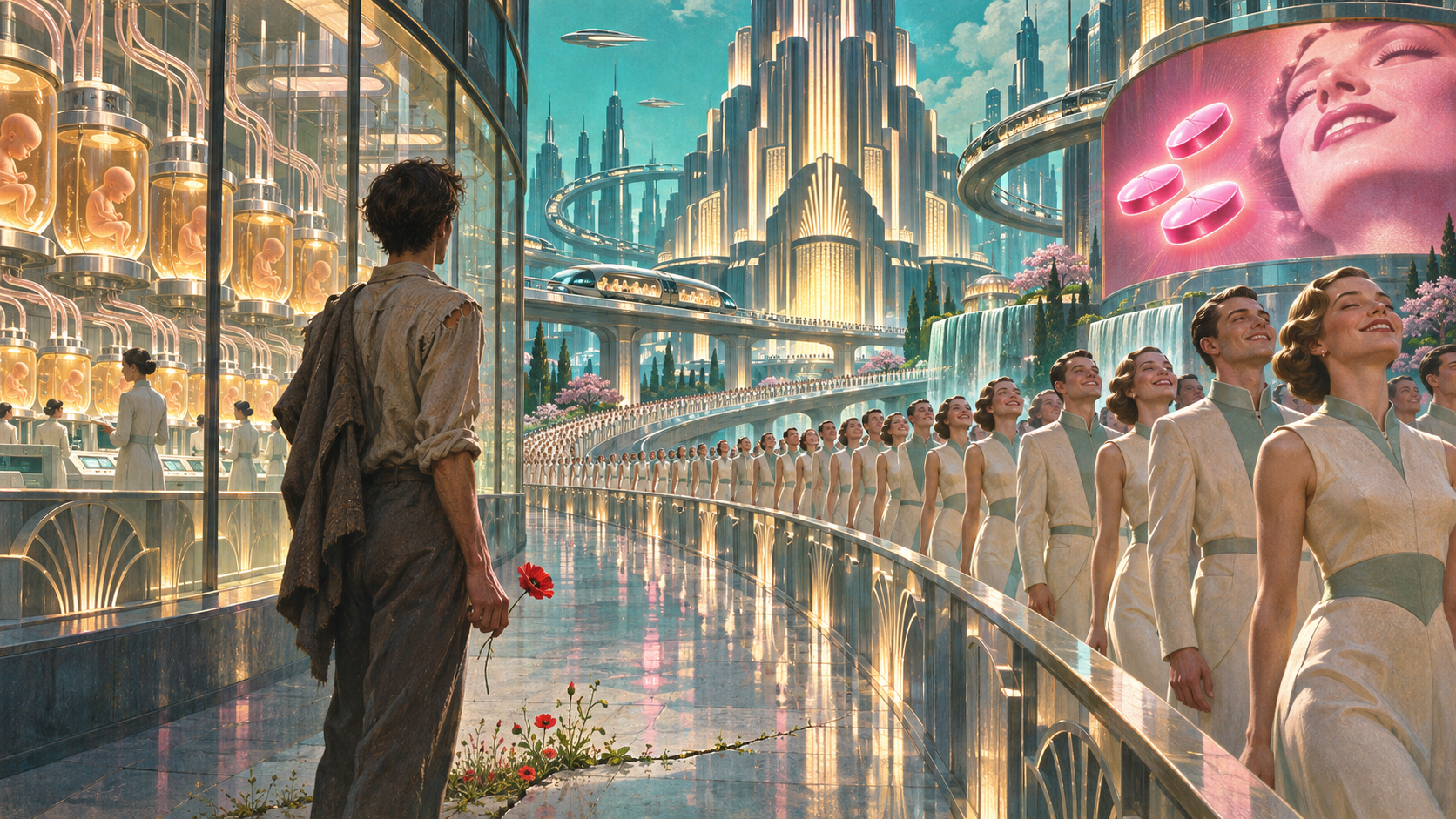
People aren’t born here. Don’t worry, there’s still sex (otherwise the novel could have been called “Brave New Hell”). They are produced in bottles, on an assembly line, at the “Central London Hatchery and Conditioning Centre” (“I’m still not sure whether this belongs to the medical or the biology faculty…” – note from my subconscious). Even before “birth”, everyone is assigned to a caste: Alphas and Betas are the elite, while Gammas, Deltas and Epsilons do simple jobs. For the lower castes there is also the Bokanovsky Process, where up to 96 identical twins are produced from a single fertilized egg. Standard people, for standard machines, in standard batches… mother of God, I’m really holding back from writing something that will get me banned…🤣 (“Me too…” – note from my subconscious)
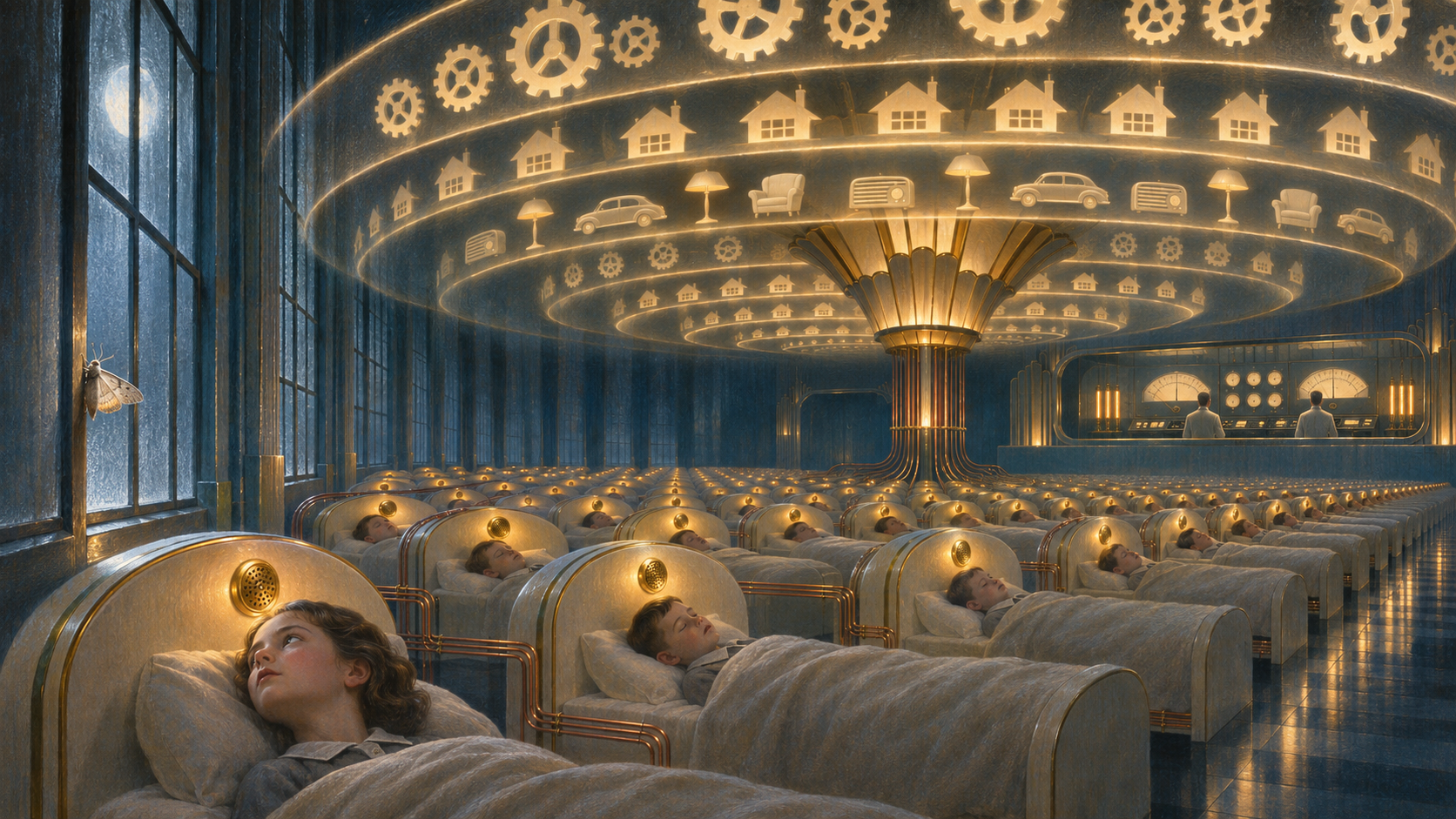
And then the upbringing begins. In one of the creepiest scenes in the book, babies from the Delta caste are given colorful picture books and roses. Just as the babies happily crawl toward them… BOOM! Sirens, explosions and a mild electric shock from the floor. After enough repetitions, these children will “instinctively” hate books and flowers for the rest of their lives. Books, so they don’t waste time on something that might make them think. Flowers, because nature is free, and free doesn’t drive the economy. That’s why they’re taught to love complicated outdoor sports, which require buying equipment and transport. A vicious circle: you work so you can buy things you don’t even know you’ve been brainwashed to love…
Then there’s hypnopaedia – learning in your sleep, where children listen to the same short slogans hundreds of times, until they become their own thoughts. Family doesn’t exist, the words “mother” and “father” are practically dirty words (not swear words, but literally something like a taboo!?), and attachment to one person is considered strange (we already have that today in some form, where you’re seen as disturbed if you believe in monogamy, loyalty, exclusivity). And if some unpleasant feeling does appear (from hatred, through disgust and lust, to love), there’s soma – a pill that, in a couple of seconds, brings you back to a state of eternal “everything is great”.
Anyway…
In this perfect world, we meet Bernard Marx, a psychologist from the highest caste, Alpha-Plus, an expert precisely in hypnopaedia. The problem is that Bernard is shorter than the other Alphas (rumor has it that alcohol was accidentally added to his blood-surrogate while he was in the bottle), so he’s insecure, withdrawn and doesn’t fit in. Unlike him, Lenina Crowne, a pretty and popular Beta who works at the Centre, fits in perfectly. Her friend even reproaches her for seeing only one man for four months, because that’s, you know, not proper. Today’s sugar babies are on life support by comparison…
Bernard’s only real (I guess) friend is Helmholtz Watson, a brilliant Alpha-Plus who writes for the system, but feels he’s writing about… nothing. And here the problem already starts to show: the system didn’t foresee that someone might be too smart (or too “defective”, so to speak) to be happy.
On one occasion, Bernard and Lenina go on a trip to a reservation for “savages” in New Mexico, where people still live the old, primitive way: they are born, they grow old, they get sick, they feel all kinds of good and bad emotions, and they believe in god(s). There they meet Linda, a woman from London who got lost many years ago on just such a trip (and so became, in a way, a “savage” herself), and her son John. John grew up on the reservation as an outsider, and the book that truly shaped him was an old copy of Shakespeare’s complete works. The man literally thinks and speaks in lines from “The Tempest”, “Othello” and “Romeo and Juliet”.
Bernard realizes that Linda and John are connected to a very important person in London (I won’t tell you who, but it’s going to be awkward for everyone when it comes out). He decides to take them with him to “civilization”, where John, better known as the Savage, becomes London’s biggest attraction overnight. Kind of like meeting an educated person today who says they still read books… and in paper format, no less…
And how a man who spent his whole life reading Shakespeare copes in a world where Shakespeare is banned and happiness is mandatory, you’ll find out if you read “Brave New World”.
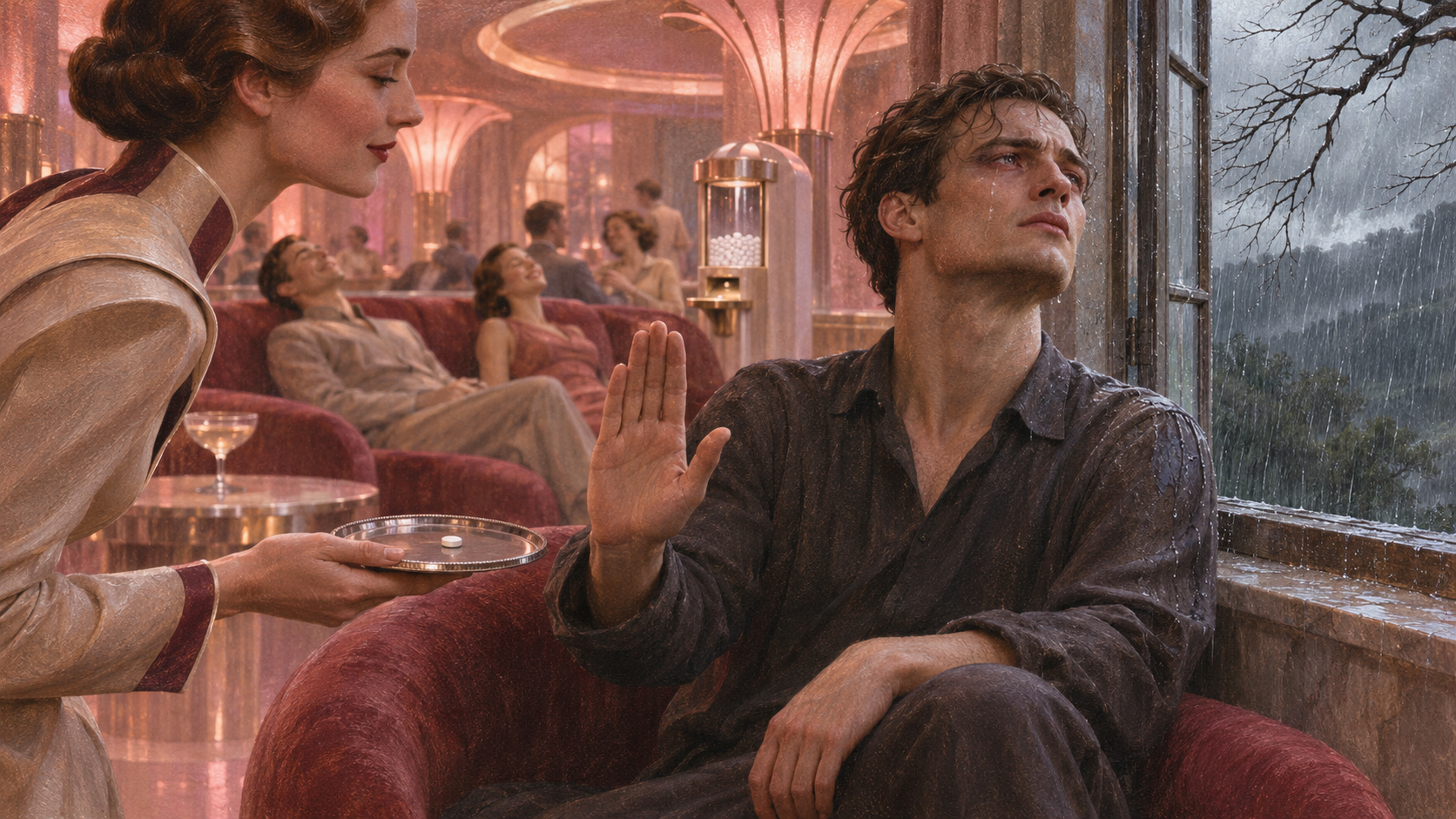
The creepiest thing in “Brave New World” isn’t the electric shock for babies, as if they were guinea pigs (however creepy that sentence sounds). The creepiest thing is that almost everyone in this world is… well… happy. Sincerely, no acting. And everyone believes they’re free. Lenina, first of all, truly believes she’s free. Free to have fun, to shop, to go to “movies you can feel” (feelies, where you don’t just watch, but physically feel what’s happening on screen), to scr… I mean, to change partners like socks, and to take soma whenever something isn’t quite to her liking (“This soma is like Aspirin, a cure for every problem…” – note from my subconscious).
World Controller Mustapha Mond, the man who understands this system better than anyone, explains it pretty coldly: society had to choose between truth, beauty, art, science for science’s sake and faith on one side – and stability and happiness (or “happiness”) on the other. And it chose the latter. You can’t have both Shakespeare and stability, because Shakespeare is full of passion, jealousy and suffering, and that makes people unpredictable. Maybe Mond, if we think about it a little more, is the blood brother of the Grand Inquisitor from Dostoevsky’s “The Brothers Karamazov”: both claim that people don’t actually want freedom, but bread, order and someone to make decisions for them.
And John, our Savage? He asks for exactly what this world has given up: poetry, danger, God, sin, struggle… and the right to be unhappy. It sounds like madness. But then you realize he’s one of the few characters in the book who actually feels something. Maybe even one of the few normal ones.
Now, let’s see how far we (as a civilization) are from all this… apparently, not very far…
Soma – I’m not talking about medication your doctor prescribed (that’s a completely different and serious story). I’m talking about how today we run away from every unpleasant thought. Bored in line at the bank? Scroll. Sad? Netflix binge. Can’t fall asleep? A shopping cart in an online store at two in the morning. In Huxley, soma is a pill; for us, it’s in our pocket, it’s 6.5 inches and the battery lasts all day… and yes, I mean the mobile phone, you perverts…
Hypnopaedia – The children in the book listen to the same slogans hundreds of times until they become their thoughts. Today we call it the school sys… I mean, ads, jingles, trends and the algorithm that shows you the same content a hundred times until you believe you’ve always thought that yourself. Why do you think there are so many male influencers today saying women are the worst, and female influencers saying men are the worst?
Consumption – Deltas learn to hate nature, because a walk through the woods costs nothing. Today nature isn’t forbidden to you, but to go to the mountains you need an app, a smartwatch, trail shoes and at least three posts on social media. Otherwise it didn’t happen. Imagine you went out with your girlfriend/boyfriend just for a walk by the river, or had a picnic in the park with your spouse and gave the kids a ball to play with. So, you bought nothing and you’re having fun for free? AND YOU DIDN’T POST AT LEAST THREE STORIES OR A GRATITUDE POST WITH PHOTOS OF THE ACTIVITY? AND YOU’RE STILL HAVING A GOOD TIME?! THAT’S A JOB FOR A PSYCHIATRIST OR THE STAKE! WHERE DO YOU GET THE RIGHT TO DENY ME INSIGHT INTO HOW YOU SPEND YOUR FREE TIME? YOU SHOULD BE REPORTED AT THE NEXT (POLITICAL) PARTY MEETING!
Castes – In my work with people, I often see how much people suffer because they’re not in the right place, or because they want more than they’re being offered. In the World State, this problem is solved in the lab… everyone is produced exactly for their job and conditioned to love it! No ambition, no burnout, no dissatisfaction. Every bad manager’s dream. That’s exactly why it’s a nightmare. JOHNATAN, IT DOESN’T MATTER THAT YOU DISCOVERED A TALENT FOR CHATGPT AND A MILLION-DOLLAR IDEA, A KID THREW UP ICE CREAM IN THE DELI SECTION, GRAB A RAG, CLEAN IT UP AND BE GRATEFUL AND HAPPY!
Emotions as a system malfunction – Love for one person is dangerous, because it creates strong emotions. Family is dangerous, because it creates loyalty that isn’t directed toward the state. Solitude is dangerous, because in solitude a person starts thinking not only about themselves, but about other things too. That’s why in this world nobody is ever alone and nobody ever has to wait for a desire to be fulfilled. So, orgies are fine, but no kissing on the mouth, please.
This might (perhaps) be interesting food for thought – in 1974, the philosopher Robert Nozick posed a famous question: would you plug yourself forever into an “experience machine” that guarantees you only pleasant experiences? Nozick’s answer was that most of us wouldn’t, because we want to actually live, not just feel as if we’re living. Some 40 years earlier, Huxley wrote an entire book about a world in which everyone said – yes.
“Brave New World” is almost always mentioned alongside Orwell’s “1984”, and I would also add “Animal Farm” and Bradbury’s “Fahrenheit 451” here. All four books deal with the same question (how do you control a human being?), but give completely different answers:
- According to “Brave New World” – the system controls people through pleasure, drugs and conditioning from birth.
- According to “Animal Farm” – propaganda, the blind followers of those in power (the dogs in the book) and constantly rewriting the rules in the interest of those in power (the pigs)
- According to “1984” – there’s surveillance, fear and pain
- According to “Fahrenheit 451” – brainwashing through TV walls, “TV families” and firemen
And in all four works, books disappear from the view of almost the entire population (or remain available only to a chosen few).
Interestingly, Huxley and Orwell weren’t just “colleagues in the genre”. In 1917, Huxley briefly taught French at Eton, and one of his students was a young Eric Blair (later known as George Orwell). When “1984” came out in 1949, Orwell made sure his publisher sent a copy to his former teacher, and Huxley replied with a letter in October of that year. He praised the book, but (in a very professorial way) added that he thought the future would more closely resemble his own world after all. In his view, rulers would realize that it’s much cheaper and more efficient to make people love their servitude than to force them into it with beatings.
(A small fun fact: in 1946, in a review of the novel “We” by Russian writer Yevgeny Zamyatin, Orwell wrote that “Brave New World” was probably partly inspired by that book. Huxley claimed he hadn’t even heard of “We” until he had finished his novel)
And that brings us to Bradbury, who is, perhaps, somewhere between these two. In “Fahrenheit”, firemen burn books, which is very Orwellian. But Captain Beatty explains that it didn’t all start with the state, but with the people themselves, who found books boring and too difficult, while the “TV family” was much more entertaining… which is (perhaps) pure Huxley. After all, Bradbury himself later said that his book isn’t so much about state censorship as about how television kills interest in reading.
And if we go back to “Animal Farm”: there, the sheep bleat “Four legs good, two legs bad” because they were told to. In Huxley’s world, the sheep would be fed, smiling, on soma, and wouldn’t even know that any other slogan had ever existed.

However (as with “Fahrenheit 451”), “Brave New World” isn’t a book you “devour”.
The first two or three chapters are literally a factory tour. The Director of the Centre leads a group of students through the laboratories and explains how everything works: bottles, castes, temperatures, conditioning, sleep-learning… It’s fascinating, but it’s also a bit like stumbling into a lecture with no coffee break. It reminds me of the first time I picked up Murakami… man, I thought the description of a single-colored elevator and the counting of coins in the main character’s pockets would never end (but then the elevator opened, Murakami’s works took me under their wing, and now I’m, you know, a collector of his books…🤣).
Second, the characters are sometimes more like ideas than people. Bernard is likable at first as an outsider, but as soon as fame knocks on his door, he shows himself in a not-so-heroic light (which was, admittedly, probably Huxley’s point). Lenina is more a symbol of a system that successfully controls people than a woman of flesh and blood, and John is sometimes so melodramatic with his Shakespeare that you want to slap him a couple of times to bring him to his senses.
And third, the depiction of the reservation and the Native people of New Mexico is (to put it mildly) outdated today.
But then you get to the conversation between John and Mustapha Mond, near the end of the book, and all is forgiven. It is (without exaggeration) one of the better philosophical dialogues I’ve read in a novel. That chapter alone makes the book worth reading.
About “Fahrenheit 451”, I once wrote that it wasn’t a masterpiece to me, but that it’s a classic because of its idea. About “Brave New World” I’d say this: as a novel it has its flaws, but as a vision… this truly is a masterpiece.
This isn’t a book that will scare you. This is a book that will, if you let it, make you a little ashamed. Because you’ll recognize yourself in Lenina, and in Bernard, and (I hope) at least a little in John.
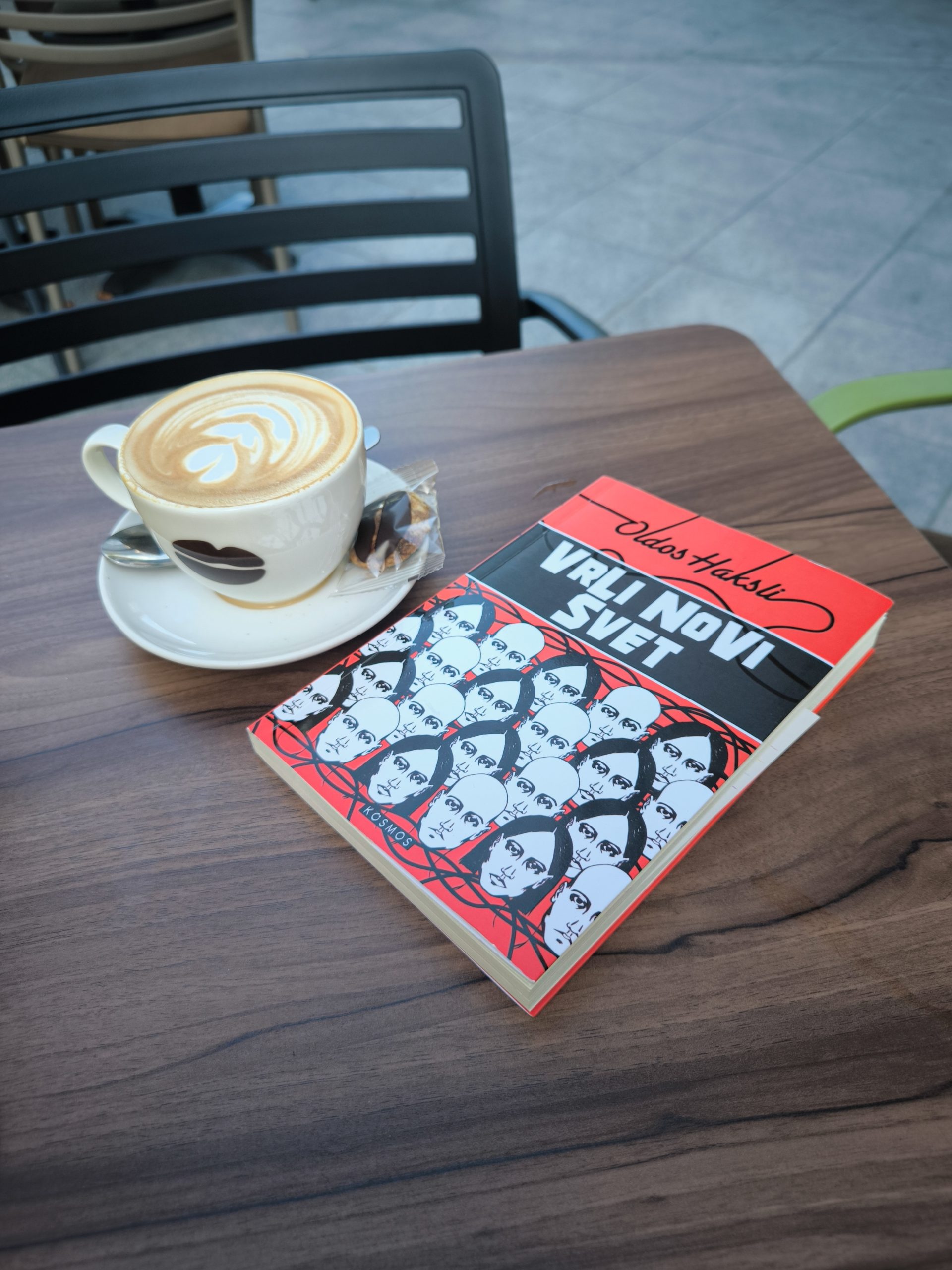
Read it. Ideally over a couple of afternoons, with coffee, with your phone switched off. If you can last without it until you finish… well, then (maybe) we’re not yet lost as human beings.
And you, dear reader, would you trade freedom for guaranteed happiness? And how many times today have you taken your dose of “soma” (scrolling, bingeing, a smoke or something else)? 😉
Rating: 4.00 / 5
Worth your time if: you like Orwell, Bradbury, Zamyatin; you’re drawn to works about the direction humanity might end up taking; you like visionary books; and it’s worth reading at least once in your life as a matter of general culture
Number of pages: 204