






Blood of Elves (The Witcher – Book 3)
“When you know something, it ceases to be a nightmare. When you know how to fight against something, the danger is no longer so great.”
And after two (introductory) story collections (“The Last Wish” and “Sword of Destiny”), it’s time for Geralt’s adventures to continue further in novel form.
Up next is “Blood of Elves”.
If you’ve connected the stories from the previous two books, now many things will be clearer to you.
Destiny again brought together Geralt and Ciri, and our witcher decided not to allow anyone to get their hands on the little princess and have her suffer further. That’s why he hides her in Kaer Morhen, an inaccessible fortress where only witchers belonging to the same order as Geralt live (and there aren’t exactly many of them now). Under the supervision of old Vesemir, Geralt, Eskel and a few other witchers, they teach Ciri how to wield a sword and develop agility – as if she were a witcher, except they decided not to subject her to initiation with various potions and mutagens and risk her life.

However, Geralt seeks help from his old acquaintance, sorceress Triss Merigold (with whom he has a slightly unusual history) to help him with Ciri. First because she’s a girl, and in Kaer Morhen there are all male witchers, who are moreover clueless about what’s needed for an ordinary girl to function. And second, because this girl isn’t so “ordinary” – although Ciri has genes of ancient elves, she herself can’t cast spells like wizards (or witchers in some form), but serves as something like a catalyst for magic and often falls into a trance when some strange prophetic voice speaks through her.
And on the other hand, the situation is such that Geralt can’t exactly easily get in touch with his (un)destined sorceress Yennefer.
But, it becomes obvious Ciri can’t stay in Kaer Morhen for long, which is why in spring she’ll go to the temple of one of Geralt’s old friends to learn a bit more everyday (temple) things, and even get an unusual and unexpected mentor to teach her understanding of magic.

And meanwhile, to protect Ciri, Geralt must distance himself from her, and sets out searching for the mysterious wizard-assassin Rience, to whom some mysterious party assigned the task of finding Ciri and killing Geralt. Rience obviously isn’t someone to joke with, because he’s merciless in his search for Ciri and has no problem eliminating people to reach his goal (so Geralt’s friend Dandelion almost lost his head when Rience found him, if Yennefer hadn’t saved him), and it seems someone powerful (both magically and financially and politically) is protecting him.
However, in the war raging between Nilfgaard and other kingdoms (relatively united against Nilfgaard and its ruler Emhyr), Ciri isn’t important only because of magical potential. She is after all the granddaughter of the late Queen Calanthe, “The Lioness of Cintra,” who while alive, pardon me, didn’t give a damn who her enemies were with their cunning diplomacy and military force. However, Calanthe is no more and Cintra is now a ruin that’s the (unofficial) province of Nilfgaard. Finding Ciri (whom the people also call “lioness cub of Cintra”) and forcing her into marriage with some ruler, would lead to Cintra really joining that kingdom and fighting heartily in war in the name of the late Calanthe and the “lioness cub of Cintra”.

Speaking of war, now it’s like a stalemate position between Nilfgaard and other kingdoms. Although Nilfgaard showed superiority, one major battle (Sodden) brought them back a bit to “factory settings” (though it seems King Emhyr doesn’t care about this at all), so the kingdoms are thinking about a counteroffensive too. However, the kingdoms have problems with “nonhumans” as well. Namely, throughout the land guerrilla units appear calling themselves Scoia’tael or “Squirrels”. These squads are primarily composed of elves, but it’s not uncommon for half-elves, dwarves, gnomes and other races to join them, and they attack humans (especially near forests), usually kill them and steal their equipment and food. However, there’s fear the Squirrels may secretly be cooperating with Nilfgaard (who surely promised them some privileges and free territories if they unite with him and create chaos within the semi-united kingdoms). And this opens the political question of how to treat members of other races who peacefully live and work in cities and would most prefer not to get involved in these conflicts.
And meanwhile, the council of wizards (who serve as advisors to kings) and their individuals have some agendas of their own.

As you can see, “Blood of Elves” isn’t just sword and magic, but also politics, and that’s what makes this series interesting.
We already mentioned in previous story collections that our titular witcher Geralt is followed by a very interesting motif – and that’s neutrality. You remember Geralt believed he was an ordinary monster-killing machine that has its witcher code and doesn’t interfere in inter-human relations and politics. However, his connection with Ciri (who is, despite their unusual relationship, something like father-daughter) and awareness that everyone wants her as some kind of trophy for their (political) powers, leads to Geralt realizing he’ll apparently have to make a choice – and that is, if necessary, to shorten the head of whoever even thinks of touching Ciri, God forbid harming her. Which leads to neutrality apparently not being a permanent option in life.
Of course, there are also motifs of (complicated) love, loyalty, manipulation and many others woven through the novel.
“Blood of Elves” reads, like previous books, incredibly easily and holds attention, and this is contributed by the fact that, unlike previous books, chapters also lead through events from the perspective of other participants scattered across the continent, not just Geralt (such as Ciri, Yennefer, Triss and Dandelion), and this enables us to gain a broader picture of what’s actually happening here, for God’s sake.

All in all, absolute recommendation to continue following Geralt’s adventures and people close to him. Of course, it’s assumed you’ve read the previous two story collections, because they give a nice introduction to main heroes and events that will follow in coming books. And of course, for lovers of the series and video games, this series is a must read.
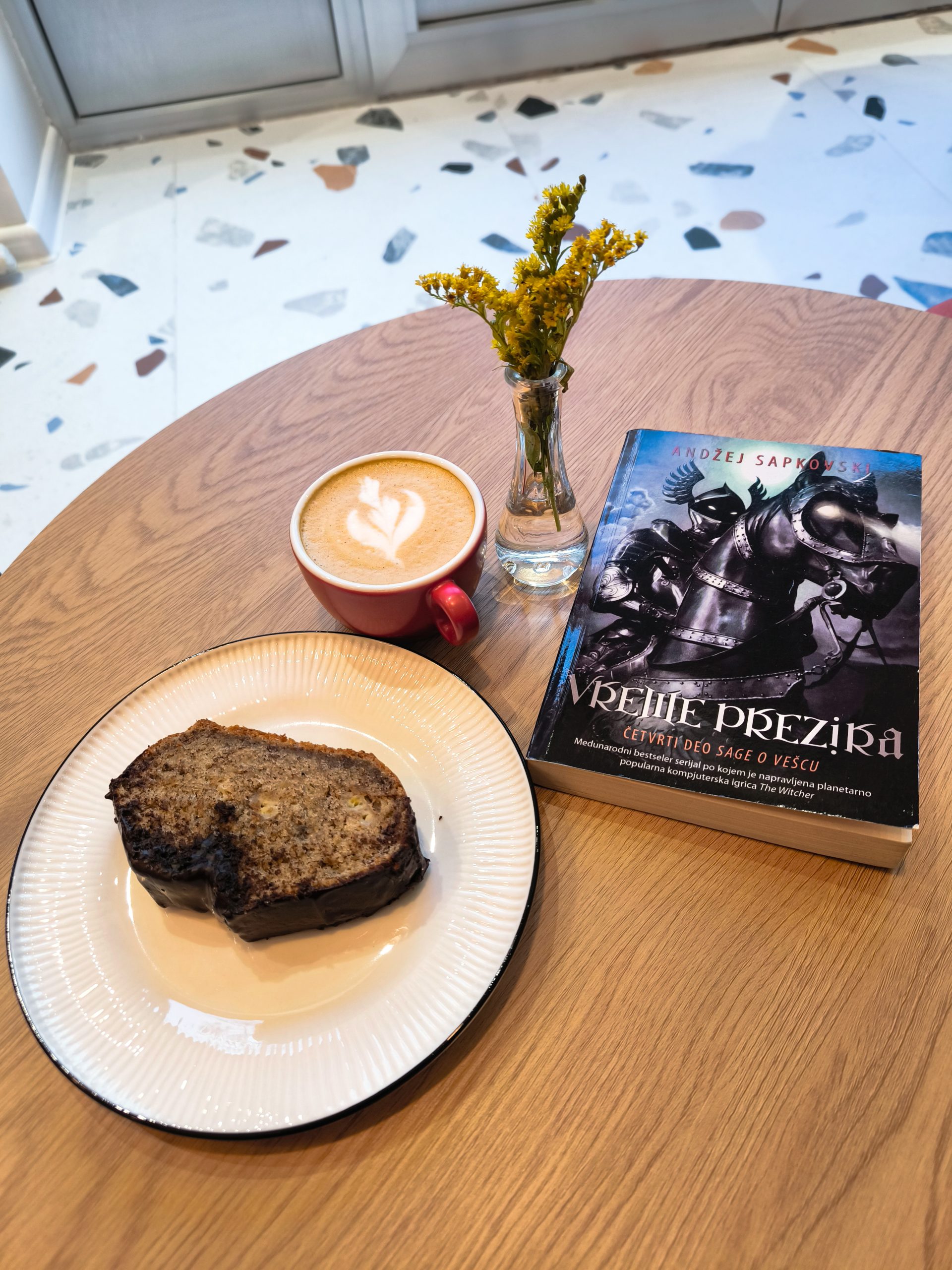
So, see you at some point in the fourth part – “Time of Contempt”! 😀
And you, dear reader, have you already read the previous two story collections? 😊
Book price: Čarobna Knjiga | Vulkan | Delfi