





The Ideal Team Player
Looking at the topic covered by the book “The Ideal Team Player,” as well as the fact that it’s quite connected to my job, for a change we’ll have a somewhat more serious and professional review, but I hope not a boring one, although my subconscious won’t participate much today, and I know it would have plenty to say (“Fine, fine… I won’t chime in today, you’re right on point…” – note from subconscious). 😀 Though, knowing myself, it won’t be a serious text all the time…
If you’re in some leadership/management/director/HR position, you may have heard of Patrick Lencioni (I think he’s best known in these parts for the book “The Five Dysfunctions of a Team”). Author of 11 books, consultant and speaker, over twenty years ago he founded his consulting firm whose focus is on how companies nurture healthy culture, teamwork and quality employee management.
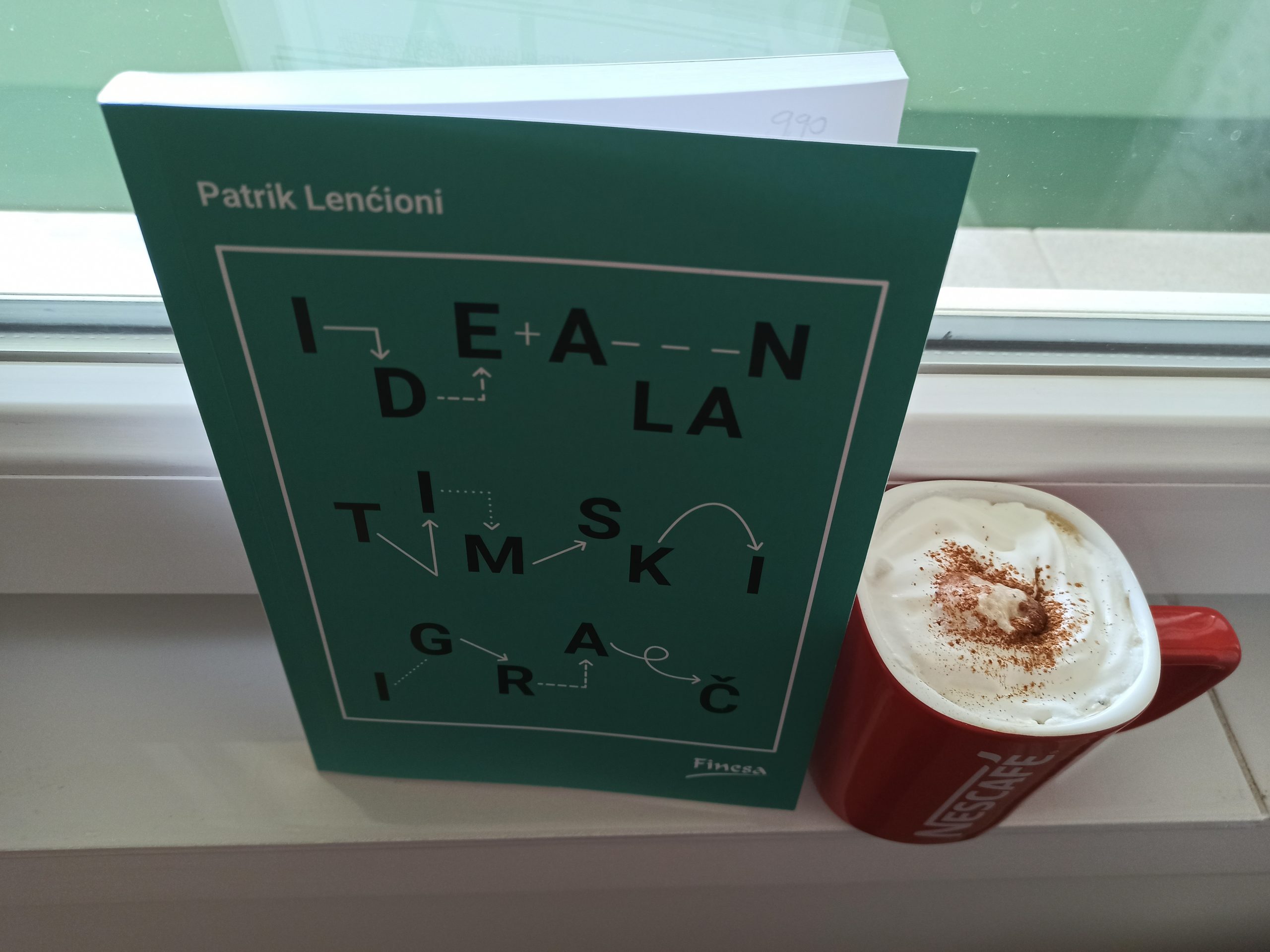
Recently, his book “The Ideal Team Player” appeared in our bookstores. This is actually a novella, and we can’t be sure whether the story is completely fictional (or perhaps represents some potentially real scenario… as Vuk Karadžić would say, “what could truly be”), or is also based on some real events. I emphasize this for the simple reason that you should consider how realistic such a scenario would be where you work.
Jeff Shanley, after 20 years of work, got fed up with Silicon Valley. He worked in marketing, started his own startup, worked for a consulting firm. He doesn’t know what he’d do next, he only knows he needs a change.
Right in that period, his dear uncle Robert (Bob) Shanley (who greatly valued his nephew) approached him for advice, hoping he could recommend some quality person who could lead his company into the future, since he’s thinking of retiring in a couple of years. After some thought, Jeff asked if he would consider him. Bob is thrilled with the idea, as he’d already worked with his nephew, and quite successfully at that.
And so Jeff moved with his family to Napa, where his uncle’s company “Valley Builders” was located. He quickly adapted to the new environment and it seemed everything was going according to plan.
However…
At one lunch together, Bob announced to Jeff that he wouldn’t wait another year, but would soon appoint him as director, which surprised Jeff a bit (not to say, scared him). It turned out that the reason for Bob’s decision was of a much deeper personal nature – namely, Bob had to have emergency heart surgery, and after that he wouldn’t be able to work anymore. He’s convinced that Jeff will manage very well. However, the situation is even more complicated, because “Valley Builders” has just started working simultaneously on two big projects (which they can’t back out of). It wasn’t Bob’s intention to dump this on Jeff (it’s his company after all), it’s just that the timing worked out that way.
The reason Jeff didn’t fall into complete despair is that he’ll be working with two executive directors who have been with the company for a long time, and with whom Jeff had excellent cooperation. We’re talking about Clare Massick (who was in charge of administration, legal matters and human resources) and Bobby Brady (chief of all company operations). The positive side of everything is that he has good chemistry with these two from the start, and they believe Jeff, although he recently arrived, is a good choice for director (and the only option, as they admitted to him). Although all three were still worried about the company’s fate.

How could they not be? Besides two new projects, they must also take care that the remaining already active projects are completed. And they’ll have to hire at least 60 more people in various positions. And this trio will need some reinforcement.
Whether this trio will succeed in finding the right people and successfully completing the projects, as well as whether Jeff will prove capable of leading the company, you’ll find out if you read the book “The Ideal Team Player.”
The main motif of the book is (somewhat obviously) hidden right in its title. Namely, Jeff (guided by his experience) took the position from the beginning that it’s very, very important that every employee is also a good team player. His colleagues basically like that idea and position, and agree that it’s very important that an employee is also a good team player.
However, what is a “team player”? That really can’t remain just at the definition of “a person who cooperates well with others in a team or group.” Does that mean it’s okay to work with someone who does their job well and efficiently (so the team can function smoothly), but is a bit “difficult” to work with? Or maybe it’s okay to have someone in the team who’s a team player, but at the same time is so ambitious that they want to take greater credit? Or would you accept a joker who’s good with everyone and creates a nice atmosphere in the team, but likes to “cut corners” at work? Maybe it’s okay to have a quiet, kind colleague in the team who cooperates well with everyone, but doesn’t really have any ambition or desire for advancement?

All these questions that trouble us, trouble our trio as well. And on top of all this comes the million dollar question – what would an “ideal team player” be like?
Well, it seems that an ideal team player would be a person who possesses traits/virtues/character/values that align with the traits/virtues/character/values of the company itself and its employees. In other words, a person who could understand and fit into what we know today under the term “company culture/organizational culture.”
And so, after some brainstorming, Jeff, Clare and Bobby defined three virtues that a team player should possess:
Humility – Great team players don’t have an oversized ego and aren’t worried about status. They quickly point out others’ contributions and slowly seek attention for their own. Perhaps the most necessary attribute of a team player. Many leaders make the mistake of often tolerating arrogant people because of their results, but don’t take into account the consequences this can have on the whole team. Also, it’s very important to distinguish two basic types of people who lack humility (openly arrogant people and people who lack self-confidence), and what they have in common is that deep down, they’re actually insecure.
Hunger – Hungry people always want more (you can put this “hungry” in quotes, or you don’t have to :)). They’re motivated and hardworking, constantly thinking about the next step, and loathe the idea that someone might recognize them as lazy. Of course, care must be taken that this ambition isn’t selfishly directed toward the individual (instead of toward the team) or that such an individual doesn’t want to dominate and take away the identity of the whole team.
Smart – (according to Lencioni, this virtue needs the clearest explanation, because we’re not talking about intellectual abilities here, but about common sense). It’s the virtue of judging well and intuitively sensing group dynamics, as well as the impact of words and actions. That would be something even, perhaps, simpler than emotional intelligence. However, attention should be paid to the fact that a smart person doesn’t necessarily have good intentions.
The question will also arise whether a team player (and potential leader) can be found within the company itself. Maybe someone possesses two of the three mentioned traits. Maybe you just need to talk to that person, advise them or refer them to appropriate training/education to improve the aspect/virtue they lack.
And so on and so forth…

At about 200 pages, both because of the simple writing style (and because of the font), the book can be read at a leisurely pace in about two to three hours (including pausing to think about what you’ve read). About ¾ of the book is the novella itself, and the last quarter is a bit more professional and speaks more concretely about the team player model and touches on:
- The history of the model and defining (according to Lencioni) the three virtues we’ve already mentioned (humility, hunger and smart)
- Categories of employees depending on which/how many virtues they lack (if 0/3: situation bad for both employee and company; 1/3: “Pawn,” “Bulldozer” and “Charmer”; 2/3: “Accidental Mess-Makers,” “Lovable Slackers” and “Skillful Politicians”; 3/3: “Ideal Team Player”)
- Application of this model in hiring, current employee assessment, development of employees who lack some virtue, as well as embedding this model into organizational culture
As for my impression…
The novella is instructive and likeable, and nicely wove the concept of “ideal team player” into the plot. I was familiar with the concept beforehand and I’d already applied some of these approaches myself. However, like all concepts/methods, it’s hard to adhere to it strictly. When I talked to a couple of people who read this book, a large number found fault that it’s very rare to find people at the top of management who are open-minded from the start for more drastic changes (like Clare and Bobby) or whose ego doesn’t blind them so much that they’re willing to accept suggestions and change their approach to their tasks (this leading trio was ready to think about their ways of doing their jobs and what they need to adjust), as well as management’s willingness to change, especially in times of great challenges (new projects) or crisis. Quite a few (large) companies (and their management) like to follow the logic (not to say maxims) of “we’ve always done it this way” or “oh, not now, do it when I retire” or “if it isn’t broken, don’t fix it.” Some companies still function with this behavior, and some have been “buried” by that same behavior. Because of that, many will see this novella more as fantasy or science fiction… or painful reality.
What is a fact is that no model is perfect, not even this one. Everything depends on how ready the people at the top of management are for changes, as well as what the company culture is like. Some value individualism and enormous ambition more, as long as results are achieved. For others, it’s important that the employee feels comfortable at their workplace, because a satisfied person is a productive person. Of course, (almost) every company’s ultimate goal is profit, it’s just a question of at what price and with what approach they’re willing to achieve it (I mean, in relation to their behavior toward employees).

However, I think the key question could be: “How ready is a person to engage in implementing changes for the purpose of positive long-term results?” A good example of this for you is HR (I won’t use the full name either in Serbian or English because I consider it degrading. It’s a matter of principle, because I work in this field), especially related to the selection process, i.e., conducting interviews. You won’t find (except by luck) a good candidate (team player) if you always ask the same generic questions to which you get the same generic answers (or extremely absurd questions to which you should get extremely absurd answers in order to, supposedly, assess the employee’s creativity):
HR: Where do you see yourself in five years?
C: I hope in your company, as a satisfied employee who contributes to results with their work (“I hope in your position, I can’t stand looking at you anymore”)
HR: What is your weakness?
C: I think it’s that I’m a perfectionist and that I believe I must complete the task at any cost (“I hate working overtime, I don’t like when they give me seven tasks simultaneously and say everything must be done by the end of the day and everything is equally urgent, I fall for hazel-colored eyes which you don’t have, and I have trouble digesting boiled cabbage”)
HR: Tell me how you handled a conflict situation?
C: Two colleagues came into conflict over XYZ task/situation and I managed to calm the situation through mediation (“A scene I remembered from some movie, but you don’t need to know that”)
HR: Sell me this pen?
C: (“Oh, for God’s sake…” – quoting Jordan Belfort and “The Wolf of Wall Street”)
HR: Why should we hire you specifically?
C: Because I believe that with my qualities and skills I can contribute to the successful results of your company (“Because I need a normal job, normal salary and to finally be able to afford potatoes for lunch three times a week”)
HR: Why did you leave your previous company?
C: Desire for new challenges, and further progress and improvement (“I think the same as for the previous question”)
HR: Are you loyal in relationships?
C: Absolutely (“Although, I have no idea why my emotional and sexual state should be correlated with my professional approach and loyalty to a company. But, if you must know, I accidentally slept with my girlfriend’s sister. And her friend. And her friend’s cousin. Also accidentally. So, unless your company employs sisters and their best friend, you have no reason to worry”)
HR: And finally. You’re at the North Pole. A minute separates you from freezing. You have a magic lamp that can grant you two wishes. Nearby is a weak old lady suffering from an incurable disease, your pet with a broken leg, the woman of your dreams who’s married to your cousin, your mother who hasn’t paid her utility bill, and your best friend who’s your brother, but you don’t know that. What wishes would you make? With this question we want to see how you’d fit into our company culture. 🙂
C: I understand, of course (“So, they could have told me the position was already rigged, and not waste my time for two months on 11 rounds of selection for working in a call center”)
Also, it’s important that management clarifies with themselves how they’ll communicate with employees, especially with those who need some form of support to be more satisfied and productive. If ego is put aside (and the attitude “Me boss, ergo, me must be smartest”) and a friendly (and professional conversation) is held, a lot can be learned about the employee and what kind of help/support they need, which can ultimately bring results to mutual satisfaction.
Boss: Radojka, we’ve noticed you’re in a bad mood and your productivity has dropped. We think an Excel course and body language training will solve the problem. You’re welcome.
Radojka: Um, thank you, yes, yes, of course (“If they’d honestly asked me the reason for my depression, I probably would have shared with them that my parrot Tića died, who was with me at the time of my divorce from my abusive drug-addict husband, but they’re probably not interested in that. And because I’m depressed, I can’t concentrate to bring this contract worth 17 million euros to conclusion. Whatever, I’ll work on this one that’s ten times less valuable… and what do I need an Excel course for when I’m a certified Level 3 in it? Body language training? Did Elon lie to me when he used to call me ‘little negotiation shark’ when I worked at ‘Tesla’? Unbelievable…”)
Boss: Stevan, I wanted to hear what your impressions are of the work so far, do you have any comments and suggestions about our work? They call it fidek now? Fibek? Feedback? Well, you know what I mean?
Stevan: (read in boss’s eyes “If says yes, then life will be hell until contract expires; If says no, then new contract for three months”). No boss, everything’s wonderful, great, fantastic!
Of course, I’m joking a bit and exaggerating some things (actually, many of these scenarios really did happen, I collected them from various but verified sources :)), but the fact is that many companies within these approaches are more “strong” in words (and pictures on social media), and less in deeds.
All in all, this is a nice and instructive book and I think it’s worth reading and studying, especially if you’re interested in the idea of finding your concept of “ideal team player.”

And you, dear reader, how do you envision your “ideal team player”?
Patrick Lencioni’s website and Tablegroup company
Book price: Finesa | Delfi | Vulkan | Dereta | iLearn
Ratings (and purchase) on foreign sites: Goodreads | Amazon | Bookdepository | Audible | Waterstones