






Serbia, God Help You
The fictitious stranger told (wrote?) us through letters to his people how unusual Serbia is to him. No doubt, we recognized ourselves in most of those letters (“Almost all?” – note from subconscious).
Is there anything else to tell about us and our mentality in a humorous way?
It turned out we barely scratched the surface.
Serbia, God help you…
No, I don’t mean this as a sad comment with a sigh (well, I mean that too), but this is also the title of Bojan Ljubenović’s book. More precisely:
“Serbia, God Help You: Diary of a Peasant.”
Meet Todor Trajković, a peasant (by profession, because otherwise he seems like a fine and straightforward man) from the village of Miloševo, Šumadija district, Serbia. He lives a classic peasant life (hasn’t gone further than Kragujevac), but thoughts about the government and opposition and sowing and harvest and subsidies and interventions and Europe and what not are increasingly bothering him. He’s afraid to speak out lest he offend someone, and thoughts have gripped him, they’ll come out his a**. Simply, he started thinking too much about everything happening in the country (and that’s never good for either person or government). And then his neighbor Crazy Lale suggests he start writing a diary and put all thoughts, excuse me, on paper.
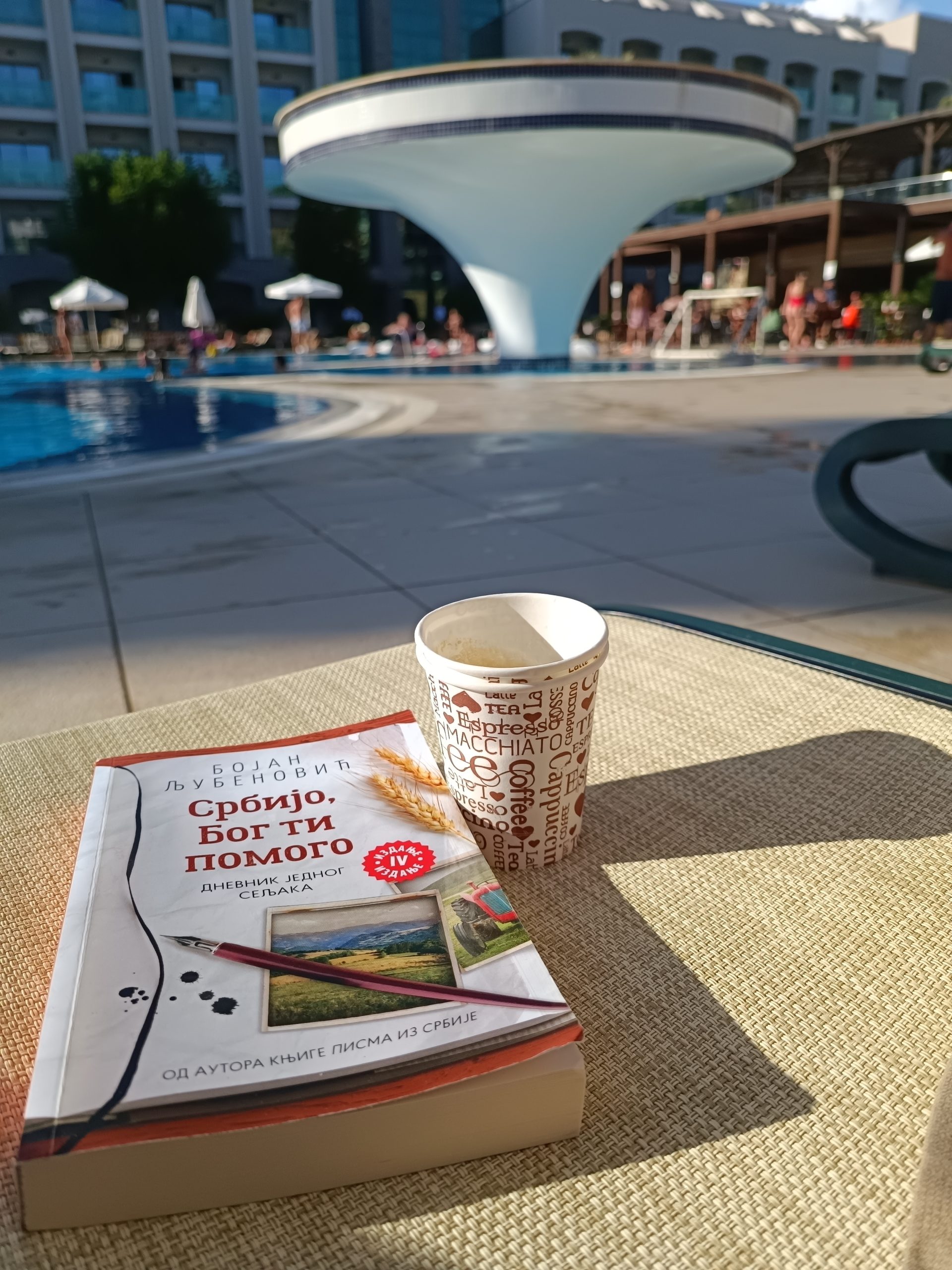
“When has anyone heard of a peasant writing a diary” – I ask him, and he says such times have come now, even the illiterate write, so why wouldn’t I, paper tolerates everything so it’ll tolerate me too, just to be careful that no one finds what I write, neither Dobrila nor the government, the spoken word goes in here, out there, but the written is different, heads will fly because of it.
“Where should I hide the diary?” – I ask him, and he says put it under the hoe, in Serbia no one picks up a hoe anymore, your diary is safest there.
And here, I’m putting it right there, Lale isn’t crazy like people say.
And so Todor will write to us through 100 “notes of thoughts” in his diary about himself. He’ll write about his family (good-natured wife Dobrila, sharp and sometimes long-tongued; son Voja who’s been studying for a hundred years and wants to deal with politics because there, realistically, you don’t really need school, and it’s more of a hindrance; daughter Jelica who diligently studies to be a teacher; and we shouldn’t forget Todor’s father, uncle Gavra, who mostly dozes under the walnut tree, but is a hidden gem full of wisdom… and tricks he knows how to prepare around the village) and his neighbors friends and acquaintances from the village and a bit wider (Crazy Lale, Raca Mechanic, Borko Ćoro, Pera Buljina, Žika Bambus, priest Fića, Cana Irrigator, Đole Six, Života Stinker, godfather Radenko and many others).
He’ll write to us about (unlucky) events that would befall him and his family, neighbors, as well as the village itself.
But actually, all the time Todor will (consciously or unconsciously) write to us about our (Serbian) peasant mentality… in fact, as I read the book, I recognized a lot of what was written in Belgrade itself, just on a slightly different level, so I wondered whether Miloševo could be some (Bel)grade municipality too..
Anyway…
Through Todor’s letters, we’ll see how people cope with (unexpected) challenges and how no one like Serbs can make a come(n)dy out of it and f*** things up. We’ll discover how neighborly relations can be good in our country (when you don’t talk with someone). That changes are good as long as they’re not fast, but are efficient, general so everyone can use them, but specific for individual’s needs in the part they need, that they’re modern but not Satan’s butter, that they’re favorable but quality done, that we amen them but someone else does them and they’re our merit though we didn’t do anything concrete and we can say something smart as if we brought them but don’t know what so we’ll just say anything (if you’ve ever wondered why changes in Serbia just won’t come, just reread this sentence). We’ll realize how vanity, arrogance, Ego, ignorance and fear (of the new/changes) are our greatest enemies. We’ll see how peasants are interested in very concrete and narrow spectrum of things… which includes the tavern, village football club, jealous neighbors, Europe, taxi, death, investing money in traffic lights, weddings, burial plots, clairvoyant Dobrila, political parties in the village, introducing internet, crops, library, which rakija is best, guest workers, revenge of Hungarian Zoltan, rivalry with Golubinci, highway construction, young people’s disinterest in estates and village life… as I said, only concrete things…
However, “Serbia, God Help You” also shows us those beautiful and positive elements of our people. The desire to help both dear and non-dear and known and unknown in moments of greatest (their) distress, will for unification when necessary, sense of humor (and sarcasm), resourcefulness and creativity, as well as (some) faith in (some) better tomorrow.
All the time while you read Todor’s diary (which always starts with Dear diary and ends with Your Todor, from which you can see Todor experiences the diary as a friend to whom he can confide and confess), a smile will hover on your face. You’ll often laugh sweetly (and bitterly) at some events and people Todor writes about because you’ll, most likely, like in the book “Letters from Serbia,” recognize them in your surroundings (and probably in yourself).
“Serbia God Help You” is written in simple yet vivid language, full of humor, wit, mockery and sarcasm, but also with deep hidden (serious and life) messages. The book is an absolute recommendation if you want to read something to relax, laugh, and also ponder the Serbian (and Balkan) mentality.
As nicely written on the back (soft) cover of the book:
“And when a Serbian peasant starts thinking, that can’t come out well”
And when I read on social networks some “thoughts” that materialize through comments of certain people’s profiles, I’m increasingly convinced there’s truth in the previous sentence…
And you, dear reader, have you recognized some “relative from the village” in this book?
Author’s website
Book price: Laguna | Vulkan | Delfi | Makart