





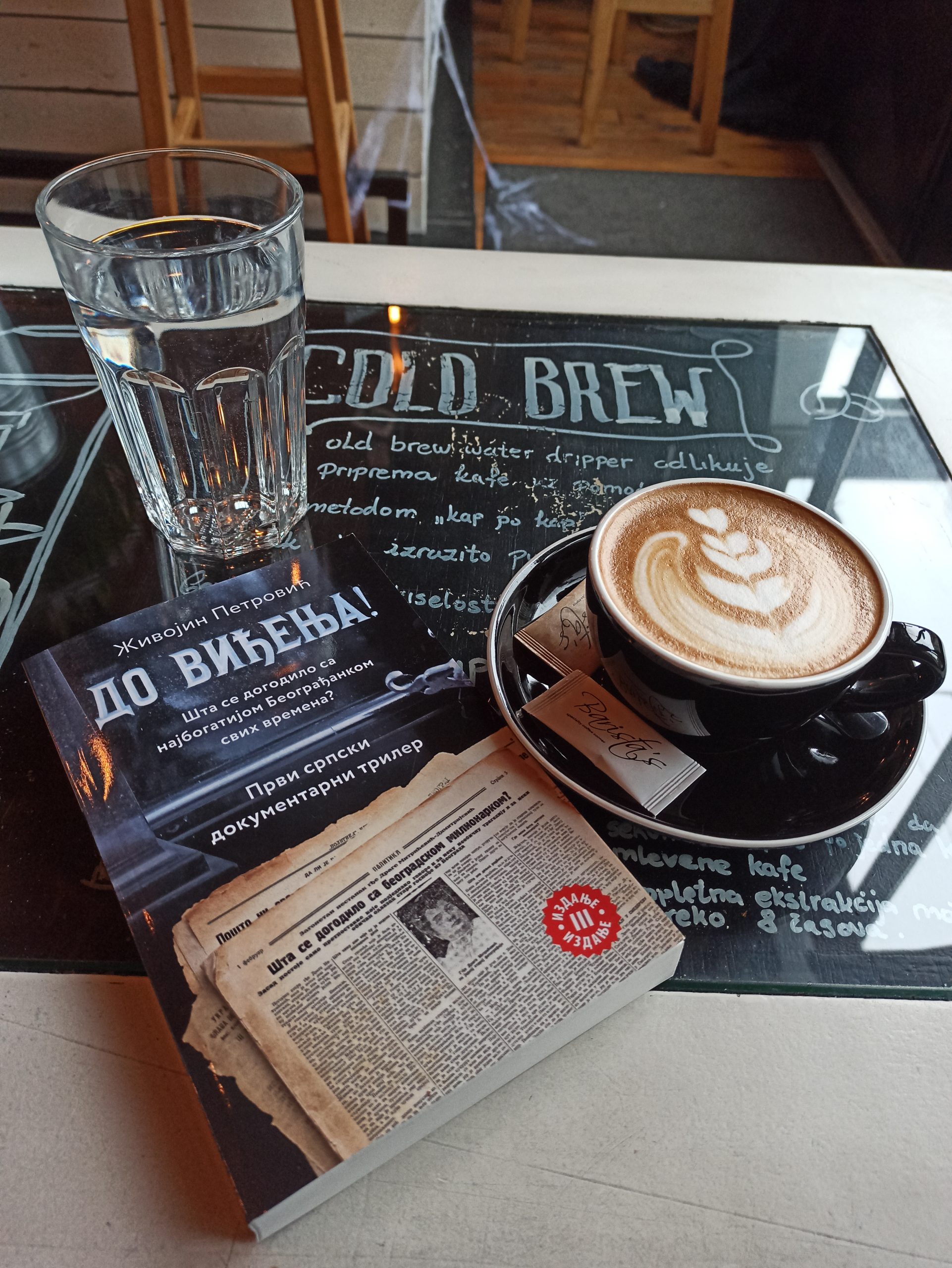
Goodbye
Somehow the novel “Goodbye” has quite an appropriate title for the first (reviewed) novel for 2021… a nice, subtle and cultured farewell sentence for 2020 (though we surely said goodbye to it much worse in our thoughts :D). And that’s where my comments about 2020 will remain…
The novel “Goodbye” by Živojin Petrović was first on the bestseller list in our bookstores for weeks, winning readers’ sympathies. After so many weeks of popularity, I too wanted to see what the audience “latched onto” so much with this novel.
On the cover of the novel it says:
“Goodbye,” and below that:
“What happened to the richest Belgrade woman of all times,” and below that:
“The first Serbian documentary thriller.”
Here are four words that made my eyebrows twist and eyes squint, so I looked like Clint Eastwood, not at all impressed by what I see.
First. Serbian. Documentary. Thriller.

It doesn’t look very encouraging and doesn’t intrigue at first glance, does it? If it were “First Serbian epic fantasy,” “First Serbian science fiction novel,” “First Serbian comic novel” or say “First Serbian erotic novel.”
But documentary thriller? Hm…
Joking aside, I don’t think I had prejudices toward the novel.
Perhaps toward myself…
When it comes to the idea of a documentary literary thriller, it somehow reminded me of the idea of watching some European drama film. I’m not much of a fan of that genre, basically I’d have to be in some “specific mood” to watch something like that, and I know I’ll be bored when the film ends. I wondered if perhaps a similar fate would befall “Goodbye”… and that I’d simply “slap together” reading the book, and maybe skip the review.
It turned out (in the end) there wasn’t much reason to worry.
About Draga Mitrićević, I basically only knew superficial information from history. A rich millionaire, of strange (eccentric) behavior, distrustful of everyone. She was reported missing for a month, and then found brutally murdered in her house. The police couldn’t discover who her killer was for a long time, and even when allegedly discovered, history never confirmed that the real killer was caught.
This is what I knew. As they say, more on the level of some general culture.

And the plot of the novel “Goodbye” could be summarized by the text on the back of the book:
“In January 1933, in the middle of Belgrade, the eccentric millionaire Draga Mitrićević disappeared. The wealthy rentier didn’t communicate with relatives, and lived with her guardians – two German shepherds, a goose and chickens – in a huge but almost empty house at 5 King Milan Street. Rada Popović, chief of the Belgrade Criminal Police Department, found himself facing the key task of his career…”
…and what a key task…
Primarily through the eyes of the police chief, Rada Popović, we’ll learn how the entire process (of attempting) to discover who killed Draga Mitrićević unfolded. And keep in mind, we’re talking about the murder of a millionaire who wasn’t on good terms with her relatives. And add to that the mentality of the Serbian (Yugoslav) people… of course, the important question arises “Who would kill Draga?”
But an even more important question:
“WHO WILL INHERIT ALL THOSE MILLIONS?”
These undistributed millions will give the police chief a headache. The late (over)granny was generally distrustful of people, including her relatives, whom she believed would poison her to get her money as soon as possible. She didn’t leave a will, largely due to her superstition. She had a short marriage in her youth (or maybe it’s better to say, romantic infatuation), and she didn’t speak with her late sister. Although she earned from renting premises, she wasn’t very willing to rent out premises near her house. Moreover, she often behaved like such a miser that she’d even “screw” people for money. And she was quite rude to everyone, and always said she loved animals more than people. Although rich, in her apartment (allegedly) she had almost no money at all, she’d even borrow, although she had various gold, ducats, valuables, bonds, shares and whatnot in banks.
For God’s sake, who would want to kill such a lovely granny?
Well, probably all of Belgrade. Half because of money, half because she behaved like a jerk toward people.
The family is, of course, devastated… maybe not so much because of granny’s death, as because now the battle for her wealth will begin. On one side you have Velibor Bora Jovanović as the direct heir, and on the other side the rest of the family who can’t stand Bora (apparently for justified reasons, because his history is quite murky and suspicious). And then you have several lawyers who are contentedly rubbing their palms (expectedly), though it seems they don’t have quite a clean conscience when it comes to the late Draga either. And suddenly an association of war invalids appears, to whom the deceased allegedly should have left some property. And now suddenly various letters appear in public in newspapers from some friends or acquaintances, in which some praise the deceased, others trash her, so they argue with each other through newspapers… and then some anonymous tips regarding the murder, then the case of missing savings booklets.
Is your head spinning from this nonsense? Just imagine how it is for poor Rada Popović, the police chief, who’s being pressured from (literally) all sides to find the killer, and whose entire career might depend on this case. Now he could use a Holmes and Poirot, right?
With the novel “Goodbye,” writer Živojin Petrović, collecting witness and defendant statements, records, documents and newspaper articles from various archives, tried to recreate and show us how the police tried to discover the killer in the thirties of the 20th century… but also how Belgrade and its residents lived in that period (as well as that our mentality apparently will never change… especially when it comes to the desire for sensationalism, trashing relatives or eternal curiosity about what’s happening in “someone else’s backyard”).
It can’t be said the writer didn’t make an effort. In 250 pages of this documentary thriller, there was room for archival documents too. Photos of Draga’s house, newspaper clippings, various letters, documented autopsy, court decisions, reports and whatnot, all in order to complete even more the feeling that we’ve been transported to the thirties of the 20th century.
I got the impression the writer didn’t want to “romanticize” this thriller too much, but to try to present and maintain it as realistically as possible in some form of “documentary historical journalistic prose” (“Admit it, you just made up this construction and have no idea what it means or if such a thing really exists” – note from subconscious). Descriptions are there, but quite moderate.
[Image placeholders]
My “challenge” with this book appeared relatively early. I felt that the first 50 pages or so I was reading somehow “routinely,” like, “ok relatively interesting”… and then I took a break from the book (this was quite a “culprit”). However, afterward I got stubborn to continue and stay patient… and it paid off. 🙂
Suddenly, new information just starts appearing in the murder case of the rich granny. However, the more it arrives, the situation suddenly becomes more and more confusing! Here Sherlock Holmes doesn’t help, this doesn’t make sense anymore. At one point, you realize you’re starting to get nervous along with the police chief. Did someone order her murder (relatives, acquaintances, people she had some business relationships with), is she just an unfortunate victim of robbers or something third? You take statements from dozens of people, everyone tells their own story, many of them lie for God knows what motives. The funeral home owner cries to high heaven, because he, factually, “on the word” of the family buried the late Draga as luxuriously as he could, and didn’t see a penny. Family dramas at you, lawyers drama at you, police drama because of you, superiors breathing down your neck… just the moment you start drinking something for nerves, right? And not something from the bistro, but something that only comes with a signed doctor’s prescription.
The idea that this really happened, and that there’s no logic in discovering the killer, drives you to turn pages faster and faster… until you reach the end and read the outcome. Although I knew the (relatively general) outcome, I still threw the book on the table at the end with a (professional reviewer) comment “Oh come on, don’t f*** with me” and laughed at the irony of the whole case.
A detail that made me enjoy the book even more at one point is when I imagined that I have some kind of narrator all the time who describes events and actions from the book to me, and then falls silent when dialogues begin, like in a typical TV documentary. I did something similarly silly with this book too. However, since it’s Belgrade, it was somehow hard for me to imagine Morgan Freeman doing narration in Serbian (though now that I’ve imagined that too, I think it would turn out hilariously good ^^).
All in all, the book reads quickly and easily, without much effort… even for a documentary genre.
Maybe some would be put off from reading this type of novel, but I think it’s worth reading, both as a matter of general culture, and to get a bit better insight into Belgrade events of the 30s. And the writer made an effort to research this (collected) material about Draga Mitrićević’s murder quite thoroughly, which is also a big plus.
Živojin Petrović is known to me from before as someone who’s a technology lover (he’s certainly known to people who read “Mobile Magazine”), and as the person behind the “Serbian Scientific Television” project which later grew into “Brainz TV,” and now also as a writer. We’ll see, if circumstances allow, maybe his previous book “Unreal, but Real” will be read sometime.
Though I think “Goodbye” was a good first choice for reading. 🙂
And you, dear reader, do you know what the secret of this “Goodbye” is? 🙂
Book price: Laguna | Dereta | Vulkan | Delfi | Makart | Korisna knjiga