






The Last Wish (The Witcher – Book 1)
“People like to invent monsters and monstrosities. Then they seem less monstrous themselves. When they get blind-drunk, cheat, steal, beat their wives, starve an old woman, when they kill a trapped fox with an axe or riddle the last existing unicorn with arrows, they like to think that the Baba Yaga is worse, that the Striga is more dishonest and that the Wyvern is more treacherous. It helps them sleep better, and dull their conscience” – Geralt
Eh, it’s been a long time since I read the (complete) series about our charming(?) witcher Geralt… will I enjoy it now after so many years?
I think the answer will still be – YES!
A good portion of people became interested in Andrzej Sapkowski’s books about the witcher Geralt’s adventures thanks to the excellent video game “The Witcher” from 2007 (as well as the next two sequels, each better than the previous, verified information 😉). Some maybe started reading thanks to the (not very successful) Polish adaptation from 2002 (“Wiedźmin” aka “The Hexer”). Though it’s interesting information that after the appearance of Netflix’s adaptation in 2020, sales of books and video games from “The Witcher” series jumped 562% compared to 2018. In translation, the writer got seriously rich thanks to video games and the “Netflix” series.
It’s hard to briefly summarize the plot given its epic character… and the fact that eight books have been written. XD
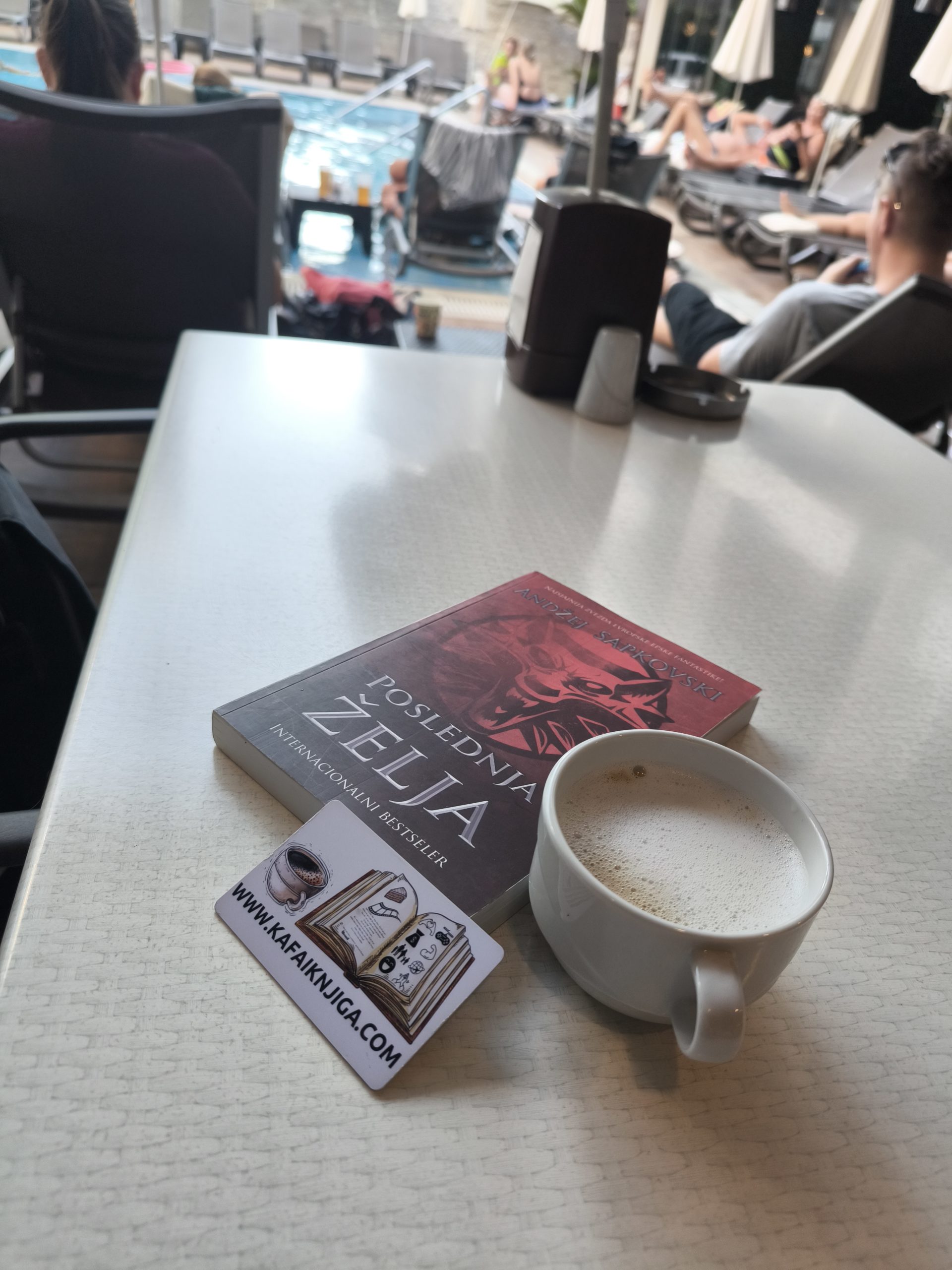
But let’s say it like this… the world of “The Witcher” is based on a fantasy medieval (European-style) continent inspired by Slavic folklore, mythologies… something like “The Lord of the Rings”. A world of humans, elves, dwarves, halflings, lizard-like, to various nymphs, dryads, sylvans and what have you. Through this continent wanders a special (and very small in number) group of people – witchers. These were mostly children without parents, who, in certain castles (i.e., “schools”), went through a type of testing (or rather experiments) on various potions, poisons and magics. Those children who survived (which would be very few), would mildly change their physical appearance, but most often would be recognizable by gray (i.e., white hair), eyes that resembled cat’s (or snake’s) and magical medallions with animal symbols (which indicated belonging to different “witcher schools”). They could use some basic (but effective) magics using symbols or signs, were resistant to diseases, as well as physically stronger, faster and more agile than the above-average (physically gifted) person, and in addition used special various potions (which would kill an average person before you could say “witcher”) that could temporarily give them additional combat abilities. They always carry two swords with them – steel for, let’s say, “everyday use,” and silver for fighting supernatural beings. And yes, they can live much, much longer than an average person, stay young-looking for a long time and have a high libido. But on the other hand, testing would always make them sterile. In addition, people are in principle afraid of them (or harass them from a safe distance) and consider them ordinary mercenaries and killers of supernatural beings who do it only for money… which is in principle true, because the only purpose of witchers is to collect bounties, i.e., kill mysterious beasts that terrorize common people and be paid for it. And as a rule, they don’t kill people and don’t interfere in their daily lives. Mostly.
Besides witchers, it’s worth mentioning another category of people, and those are sorceresses and sorcerers (or mages, and somewhere they also say witches) who wield powerful magics and most often are in the service of some ruler, but also have their own personal magical council. Interestingly, all sorceresses look sexy and voluptuous… and many changed their appearance thanks to magic as well, but for them too this often comes at a price, most often through sterility, and also that people have quite conflicting opinions about them because of their often arrogant behavior (which they can afford, because they wield great power)… something like if they were Kardashians or Kanye…
However, this continent is divided into many kingdoms, duchies and what have you, and there rule both small and large political behind-the-scenes games, intrigues, conspiracies and alliances (both between humans and races), so you never know where you stand.
And on the road it’s never safe, because you’re never sure if something will eat you or… well, replace in the previous verb D with F… and it’s not exclusive that both things will happen to you… and not necessarily in the order you’d expect.
And in such a very lively Middle Ages, wanders a witcher named Geralt, to whom fate assigned a very important role, which will affect both him and some people he’ll meet, which we’ll discover through the books.
But let’s go in order.

Before us is the first book, and that’s “The Last Wish”. This is, in fact, a collection of, at first glance, unconnected stories (which at first glance don’t really have a logical chronological sequence), in which the central figure is precisely Geralt.
However, are the stories really unconnected?
There are 13 stories:
- “The Voice of Reason 1” – on just one page, an intimate moment between the witcher and a mermaid is revealed to us
- “The Witcher” – Geralt meets with Velerad, castellan (something like an administrator of a castle/fortress) of the city of Vizima, after a showdown with locals in a tavern. It turns out Geralt just wanted to get a chance to talk (in any way) with one of the chiefs, regarding a “job posting” he found at one of the crossroads. The task – King Foltest offers quite a few orens (currency, like ducats for example) to the person who removes the curse from his daughter, because of which she was born as some kind of creature. The king didn’t have the heart to kill her, so he locked her in a nearby castle… but it turned out the girl grew, as did her teeth… with which she could rip out anyone’s stomach or eat a person (and most often both). It turned out the girl became a striga because of the curse, and while many are of the opinion she should be killed, Geralt is convinced that, if he spends the night in that castle where she is, he can remove the curse with his methods. However, some people don’t like the idea of simply removing the curse from the king’s daughter
- “The Voice of Reason 2” – connects to the first story. We learn Geralt is in the temple of the goddess Melitele and that the high priestess (and friend) Nenneke, a robust good-natured woman of very sharp character, is treating his wounds. The mermaid from the first story is Essi, who has some history with Geralt. Geralt and Nenneke argue about whether Essi should enter a trance and apparently see (i.e., prophesy) Geralt’s fate, which Geralt doesn’t like at all
- “A Grain of Truth” – we catch our witcher who (on his faithful horse Roach… by the way, he calls every one of his horses that) is wandering and comes across a ravine where there are two corpses that were apparently slaughtered by something “supernatural”. The road further leads him to an old and dilapidated castle, whose owner is one unusual creature, but not like the monsters Geralt encounters in his profession. Namely, this beast is intelligent like a human and is called Nivellen… was he perhaps once human? And Geralt is now his guest at a very unusual dinner. What secret does Nivellen hide, who seems to have no luck in love?
- “The Voice of Reason 3” – Just as he’s somewhat recovered in the temple with Nenneke’s help, soldiers in the service of a duke (Hereward) who rules these parts arrive and want to forcibly expel Geralt from these parts, which doesn’t please Nenneke at all, who is apparently God and master on the temple territory and, pardon me, doesn’t give a damn who’s in power. On the other hand, Geralt would like to avoid unnecessary bloodshed (others’, not his)
- “The Lesser Evil” – Geralt arrives in the town of Blaviken, whose elder he knows and unloads a kikimora’s corpse in front of him, thinking there’s a reward for it, because it was wreaking havoc nearby. However, the village didn’t post any notice, but they suggest to Geralt to take the kikimora’s corpse to the wizard (master) Irion, who has been living in Blaviken for a year. It turns out Irion is none other than the wizard Stregobor, who isn’t exactly in Geralt’s good graces. However, now Stregobor begs Geralt for help. Namely, Stregobor is the target of a gang led by young Renfri, with whom Stregobor has history, since her childhood. Can Geralt prevent potential bloodshed and resolve the conflict peacefully?
- “The Voice of Reason 4” – Geralt apparently has a conversation with Essi (i.e., he talks, and she listens), and reveals a piece of what’s on his soul and won’t give him peace
- “A Question of Price” – Geralt, at the request of mighty Calanthe, Queen of Cintra, attends a feast in honor of her daughter Pavetta. Various suitors arrive (among them envoys from the kingdom of Skellige, with whom Calanthe would like an alliance), and Geralt (who is disguised as a local nobleman), spends a large part of the evening in an unusual conversation with the queen, who emphasizes to the witcher that he’ll have a serious task he won’t be able to refuse. And in the end it turns out mystical powers are at play this evening, as well as Destiny and the Law of Surprise. But can the witcher oppose such forces?
- “The Voice of Reason 5” – the witcher receives a visit to the temple of Melitele (since the duke’s people haven’t chased him away yet) from his good (and perhaps only real) friend, the famous poet, ladies’ man and fencer Dandelion
- “The Edge of the World” – Geralt and Dandelion arrive in a village, in whose field dwells a devil who plays tricks on the local farmers and gets on their nerves. Intrigued, Geralt tries to solve the mystery of the devil, and even meets him… but he’s not the kind of devil he expected… and the devil doesn’t make trouble and torture farmers with his pranks without reason…
- “The Voice of Reason 6” – Geralt and Nenneke have a serious conversation. Geralt believes it’s time to leave the temple because he’s recovered enough and doesn’t want to make problems for her with the local duke. But Nenneke confronts Geralt with the fact he’s afraid he might accidentally meet the sorceress Yennefer here
- “The Last Wish” – Ah, as expected, the most important story in this book. I won’t reveal much to you. The essence is this story reveals how the witcher Geralt and the sorceress Yennefer met and how a genie from a jug who grants wishes forever changed the fate of these two and bound them with an inseparable bond, in which love, passion, rage, suffering, sadness and one (seemingly) unsolvable situation are mixed that raises the question whether there can even be a happy ending for these two… ever…
- “The Voice of Reason 7” – The witcher has (accompanied by Dandelion) finally decided to leave the temple of Melitele, but the duke Hereward’s soldiers really want to complicate their own lives. Specifically, young knight Tailles challenged Geralt to a duel, and the “judge” will be the honorable dwarf Dennis Cranmer, captain of duke Hereward’s guard (though everyone calls him, undeservedly, prince). By the way, Tailles is the duke/prince’s favorite. Here the question isn’t whether Geralt will win the duel, but whether the young and foolish knight will keep his head on his shoulders. But, an important element of this story is revealed at the end, when Essi accidentally touches Geralt while saying goodbye, so for a moment she, Geralt and Nenneke see a vision of Geralt’s fate
Even if you weren’t previously familiar with this witcher’s adventures, there’s a probability you can from this overview of stories somewhat piece together what might happen in the future. For those already familiar with “The Witcher” series in some form, the stories will seem very sensibly arranged.
The essence is “The Last Wish” slowly draws us into this unusual world and introduces us to Geralt and some other important figures who will appear (later too) in the series.
It’s very interesting how from the start the writer Sapkowski easily draws you into his world. Many books from the epic fantasy field often have the challenge of having to gradually introduce readers to their complex world (which can lead to a slow pace of the work). But these books are literally easy to read, like you’re watching a movie or series. Hop, and right from the start we follow Geralt, about whom we only know he’s a man with mildly supernatural abilities (for which he paid a great price) and kills various dangerous mythical creatures for money, but doesn’t hurt people (except in self-defense… mostly) and has some code. But, through his interaction with other people (and his occasional internal monologues) we slowly piece together a picture of him, as well as the (fantasy medieval) world in which he dwells.
All this leads to the stories reading incredibly easily and quickly.
All in all, whether you’ve played “The Witcher” games or watched Superman swinging a sword in “Netflix’s” adaptation or you’re a lover of epic fantasy… or you’re none of the above… the recommendation is to start reading this series, starting from the first part – “The Last Wish”.
Keep in mind, this isn’t some fantasy lemonade about a hero who swings a sword and saves the love of his life, gains lots of friends and where there’s an obvious happy ending! Oh no, my dears, this is a very serious and dark series.
And it would be a great shame not to read it (at least once). 😊
And you, dear reader, have you encountered Geralt and his adventures before? 😊
Book price: Čarobna Knjiga | Delfi