





Slavic Mythology
A large number of people love mythology. Here, me first! 🙂 Starting from Greek, through Egyptian, Norse, to Indian, Japanese and Chinese mythology.
Most often they’re in the form of fantasy tales about the relationships of heroes and gods, great wars, encounters with mythological beings, stories about the creation of the world and whatnot. These myths also reveal to us the roots of some customs, traditions, beliefs, as well as the way of life of our ancestors.
Slavic mythology, unlike others, is in a somewhat specific position. Let’s say, when you go to a bookstore and ask them to take you to the section where the myths of the world’s peoples are, you’ll most likely find quite a few books on this topic, but in most cases, these will be the myths of the aforementioned peoples. As for Slavic mythology, you’ll find very little there, right?

That’s why it’s nice when such a book appears, like “Slavic Mythology,” which was compiled by Nenad Gajić. According to his statement (at least that’s what it says in the book), he dedicated several years to studying and collecting material on Slavic mythology, trying to create some kind of systematization. And I think he did a pretty good job.
What will immediately catch your eye is the quality of the book, starting from the hard covers and beautiful cover art. And the interior of the book consists of about two hundred pages of texts/articles, filled with beautiful drawings by our various illustrators. If you know someone who’s a mythology lover, this is more than a quality gift.
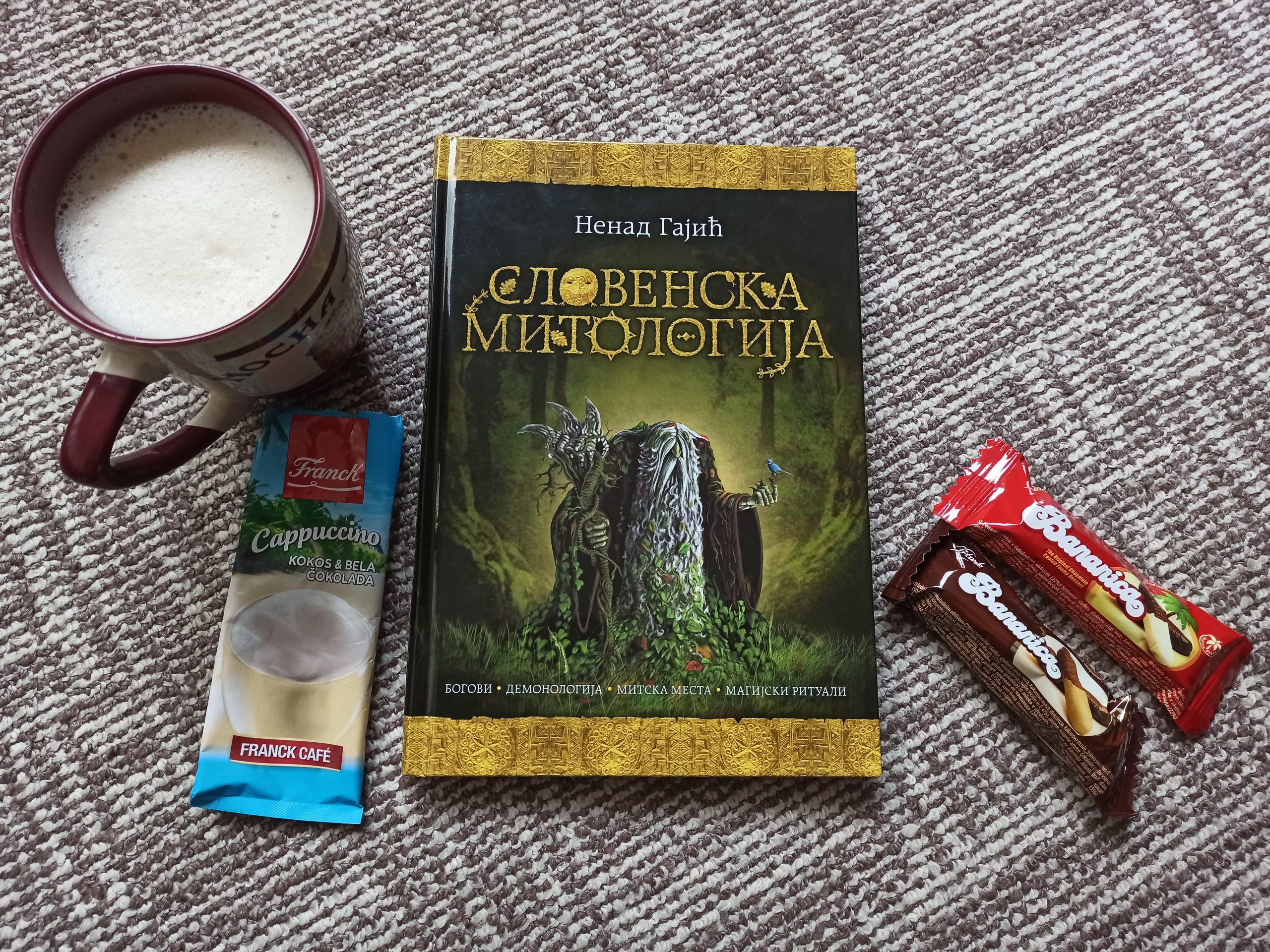
What can be found in the book “Slavic Mythology”? To simplify, it’s divided into five “areas”:
About the Ancient Slavs – here we’ll get acquainted with the origin of our Slavic ancestors, the first scripts, religion (i.e., the relationship with early Christianity), as well as some of our characteristic and specific customs, especially those related to godparenthood and hospitality
Gods – here we’ll hang out with Slavic gods such as Svarog, Perun, Stribog, Chernobog, Triglav, Veles, Dazhbog, Vesna, Morana, Mokosh and many others. There are also texts about the gods’ horses, as well as temples and sanctuaries
Mythical Places – you’ll learn what the Slavs’ beliefs were regarding fortresses, cemeteries, watermills, crossroads, caves, as well as what makes locations like Vitor Mountain, Žutibor and Trojan’s City special
Magic – what has perhaps remained most rooted in our (even current) customs and beliefs. You’ll discover the meanings and power of spells, alovitost, oak (yule log), herb wreaths, dragon heads, various types of waters (untouched water, water from horseshoes, water of forgetting and others), silent language and some more…
Mythical Beings – the most extensive (and perhaps most interesting) chapter. What did ala, dragons, angel, bauk, vampire, witch, vila, water spirits, wolf, zmaj, snake, lesnik, mora, rusalka, todoroci and many other (both real and mystical) beings and creatures mean to the Slavs

What I can tell you is that here you shouldn’t expect classic “fairy tales” like in other mythologies, about the adventures of gods or people’s encounters with mystical beings. Here you get more, so to speak, research into these concepts and names. But don’t think these are some kind of boring texts. Quite the opposite! The texts are very interesting to read and you’re keenly interested in what you’ll discover next from the material or learn something new. Yes, you read that right, learn.
This is, in a way, also a book about general culture, about how well you know Slavic customs, traditions and some behavior patterns that have been retained to this day, both in villages and in cities. If you delve more carefully into reading, you’ll realize that Slavic mythology and beliefs have survived to this day, despite the fact that the Slavs accepted Christianity. Moreover, the Christian church realized that it would never succeed in eradicating many customs and beliefs of the Slavs, so it subtly adapted Christian beliefs and behavior patterns. You’ll probably notice how many of our saints are in many ways similar to Slavic gods, especially in the “powers” they possessed, and how many saints became protectors of certain cities and villages and families (just as some Slavic tribes once favored certain gods more than others). You might not have known that angels exist in Slavic beliefs long before the appearance of Christianity, and that there’s a belief that every person has their guardian angel? Did you know that there is (after all) a difference between ala, aždaja and zmaj (and that one of these beings isn’t evil by nature at all)? Did you know that the most famous “representatives” of Slavic peoples are the dragon, wolf, vila and snake (and why peoples from these areas are said to be “dragon-spirited” or “blood brothers with wolves”)? How did the whole world adopt our term “vampire”? And you’ll learn much more in this book.

Another nice detail is that the book is interwoven with quotes, sayings and parts of folk (epic) songs that are connected to the topic being discussed.
I already mentioned that the drawings are beautifully done for this book and our illustrators did an excellent job. The drawings generally try to follow the topic covered on the page. It happens that sometimes they’re not connected to the topic, but that doesn’t diminish the impression at all, because the drawings are excellently incorporated.

This is a book for all generations, although I can’t shake the impression that the older you are, the more you’ll enjoy this book, because you’ll discover quite a few details that you’ll be able to connect with the region you come from, as well as see what has been retained from it to this day. And that’s why this book is also an excellent gift.
All in all, a very beautiful book, as well as a recommendation for it, especially for lovers of mythology and Slavic customs.
And you, dear reader, how well do you know Slavic mythology, as well as our customs? 🙂
Official “Slavic Mythology” website
Author Nenad Gajić’s website
Book price: Delfi | Vulkan | Makart | Laguna